

Every week I’ll provide updates on the latest trends in cloud software companies. Follow along to stay up to date!
The New RL Training Grounds
The earliest days of reinforcement learning were fun to watch. Algorithms trained on Atari games, Starcraft, Go. The appeal was obvious: constrained digital sandboxes with clear rules, infinite repeatability, and instant feedback. You could run agents a million times through Pong and see them get better.
But those environments were toys. Beating Pong doesn’t teach you how to navigate a hospital system. A high score in Breakout doesn’t tell you much about running a logistics network. The truth is, if agents are ever going to matter in the enterprise, they can’t just be dropped into the real world raw. They need environments to train in. Environments that mirror the messiness, constraints, and complexity of reality.
And this is where things get interesting. You could argue the next “killer infra company” is the one that figures out how to take messy, real-world systems and turn them into trainable environments. Imagine a company that builds a digital twin of global supply chains where agents can practice routing and exception handling. Or an environment that looks like a financial market, complete with noise, shocks, and adversarial actors. Or healthcare workflows with all the uncertainty, missing data, and human-in-the-loop steps that exist in reality. And this is where it gets really interesting. Every company has bespoke workflows, bespoke software, bespoke operating procedures, etc. You could have two software companies competing in the same space, using the same software stack. But how they engage and use that software (they both probably have different custom implementations of Salesforce) will vary. So in order for an agent to effectively automate their work, the agent first needs to learn how employees of each company do their work! Which brings me back to what I said above: the next “killer infra company” will be the one that figures out how to take messy, real-world systems and turn them into trainable environments.
There’s a second layer to this too: environments by themselves aren’t enough. They’re raw substrate. Enterprises won’t just want a simulation, they’ll want a way to integrate it into their stack. They’ll want observability on how agents are performing. They’ll want evaluation harnesses, orchestration, policy management. In other words, middleware. Just like Stripe turned payments into an API and Datadog turned logs into dashboards, I think we’ll see middleware emerge that makes environments usable, safe, and scalable for enterprises.
So if the last decade of AI was about collecting as much static data as possible, the next might be about constructing dynamic environments. The winners won’t just be whoever builds the best model or agent. It will also be the companies that own the environments those agents train in, and the middleware that turns those environments into enterprise infrastructure.
For larger companies, how they’re able to set these up for their own specific domains or workflows will be critical. Every company has different workflows, different requirements, etc.
Models needed data. Agents need environments. And the companies that own the environments, and the rails around them, might end up being the most important infrastructure businesses of the next decade.
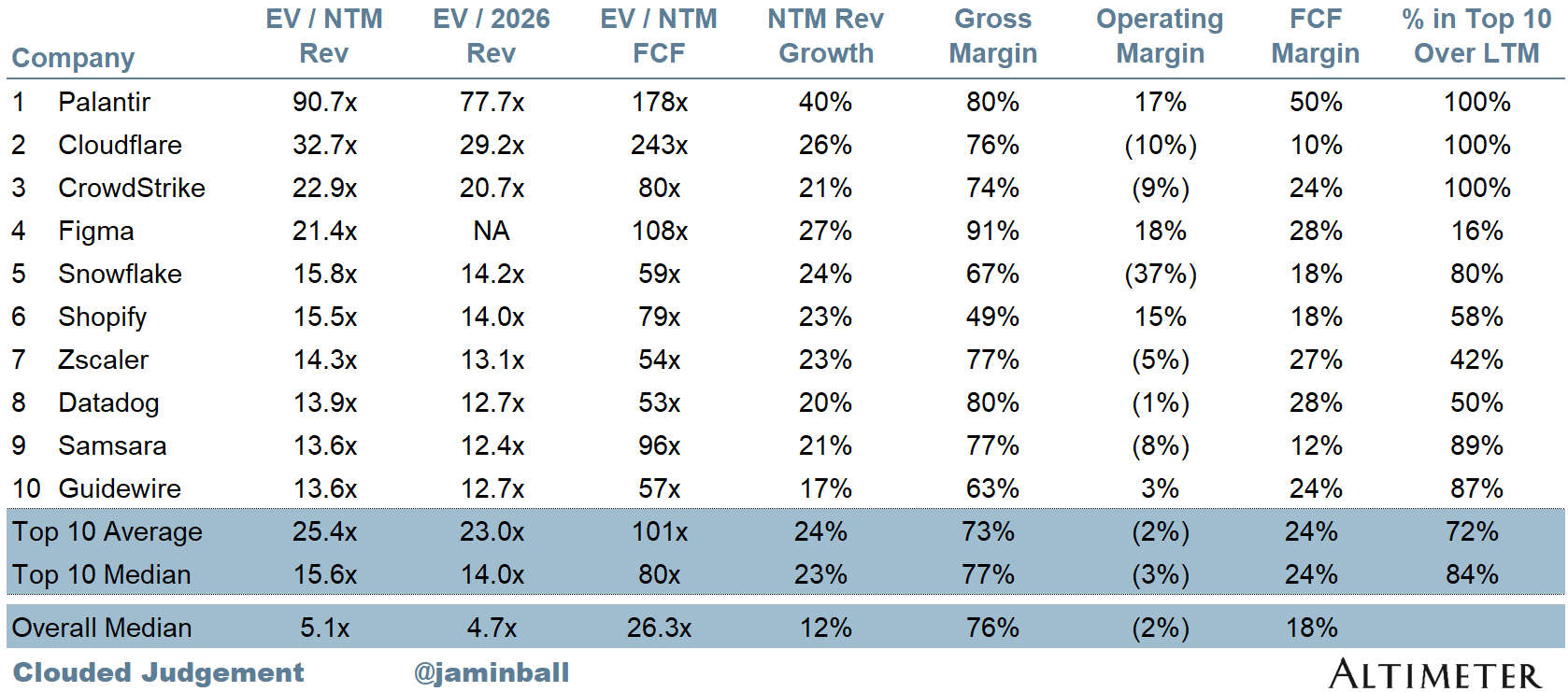
Top 10 EV / NTM Revenue Multiples
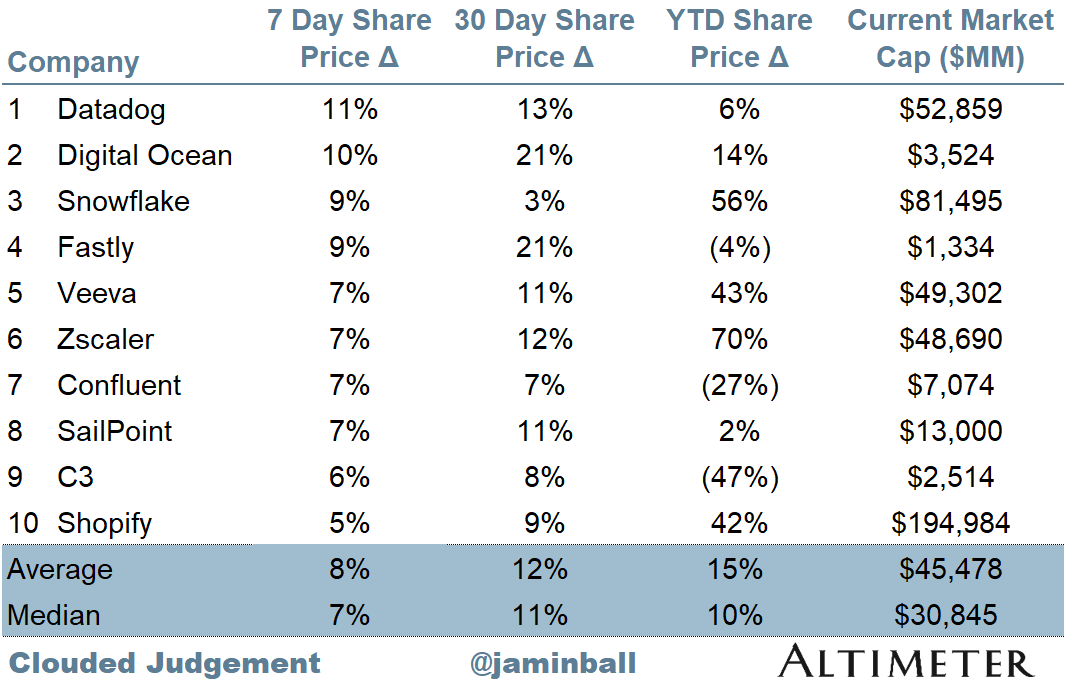
Top 10 Weekly Share Price Movement
Update on Multiples
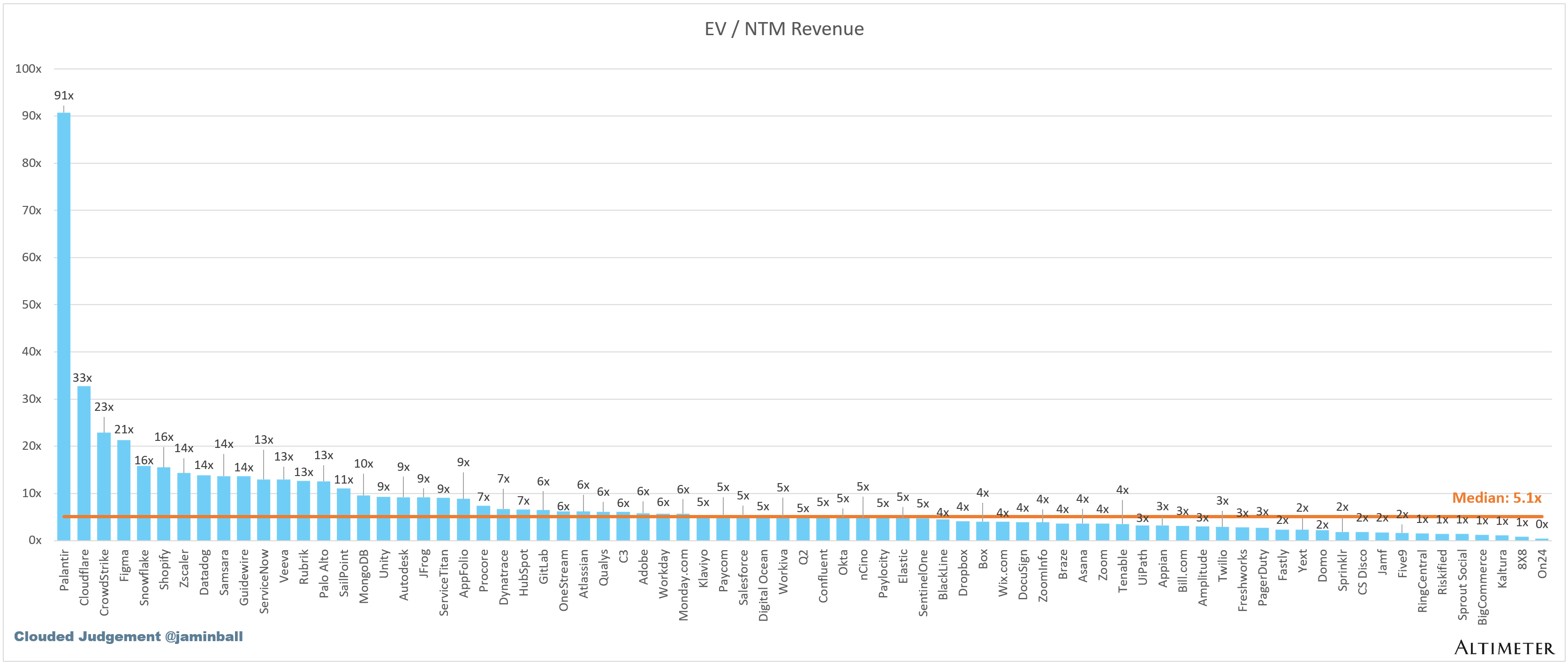
SaaS businesses are generally valued on a multiple of their revenue - in most cases the projected revenue for the next 12 months. Revenue multiples are a shorthand valuation framework. Given most software companies are not profitable, or not generating meaningful FCF, it’s the only metric to compare the entire industry against. Even a DCF is riddled with long term assumptions. The promise of SaaS is that growth in the early years leads to profits in the mature years. Multiples shown below are calculated by taking the Enterprise Value (market cap + debt - cash) / NTM revenue.
Overall Stats:
Overall Median: 5.1x
Top 5 Median: 22.9x
10Y: 4.1%
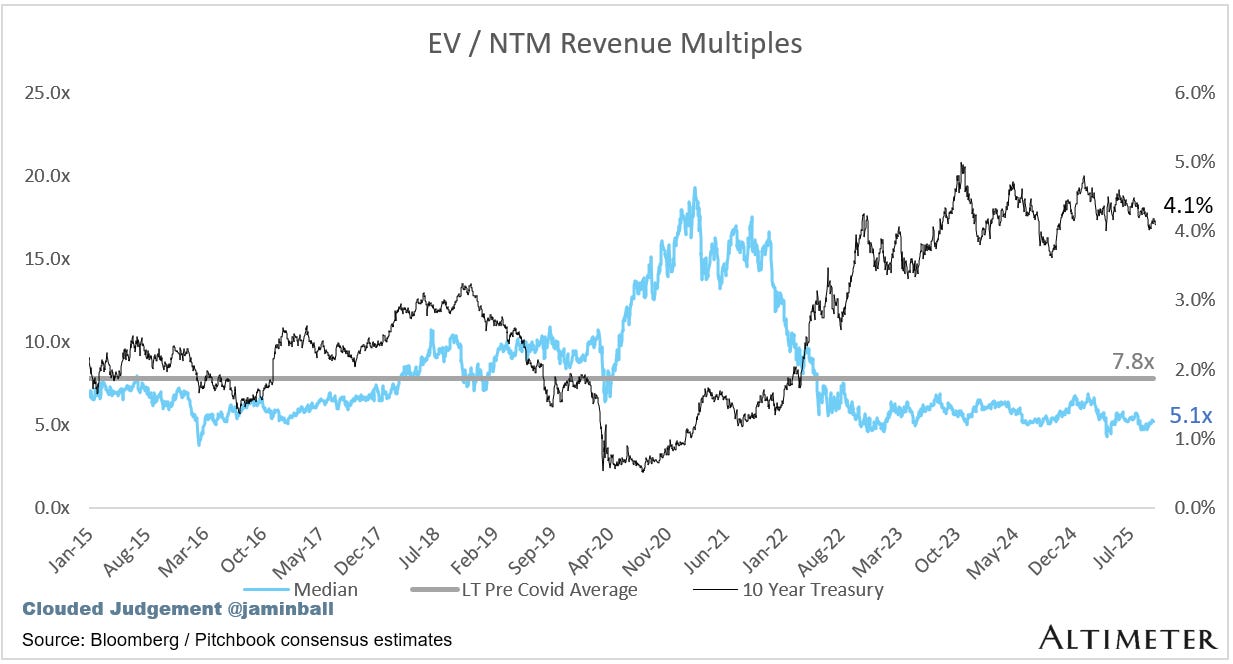

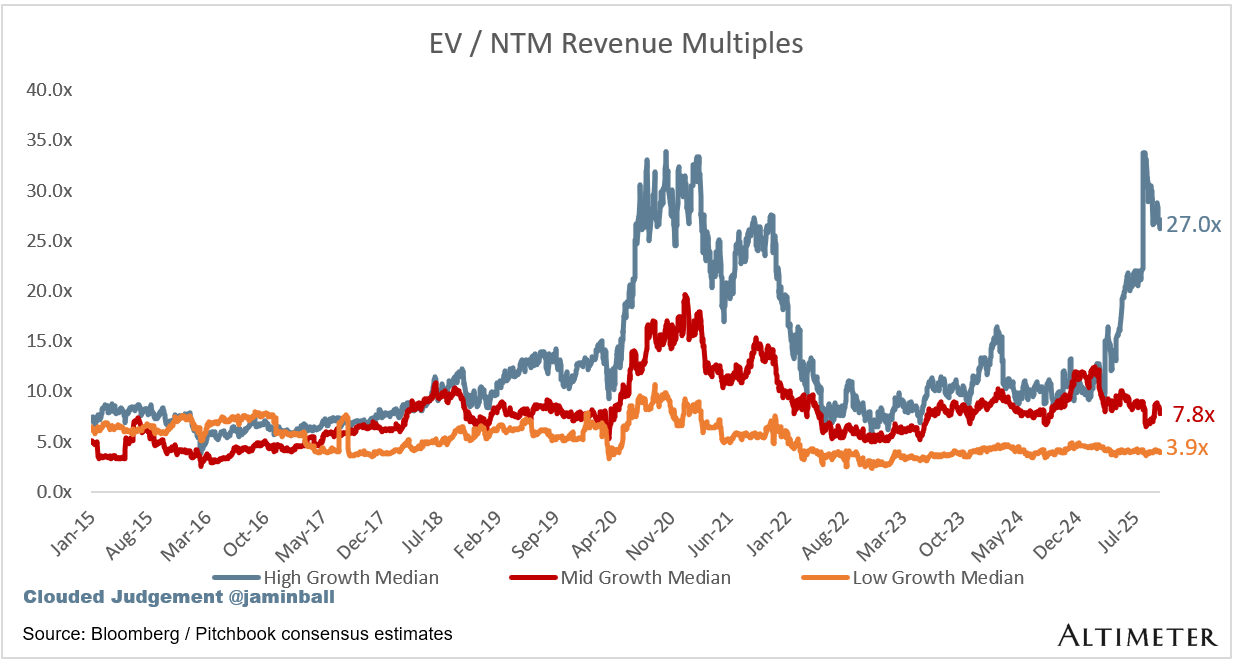
Bucketed by Growth. In the buckets below I consider high growth >25% projected NTM growth, mid growth 15%-25% and low growth <15%
High Growth Median: 27.0x
Mid Growth Median: 7.8x
Low Growth Median: 3.9x
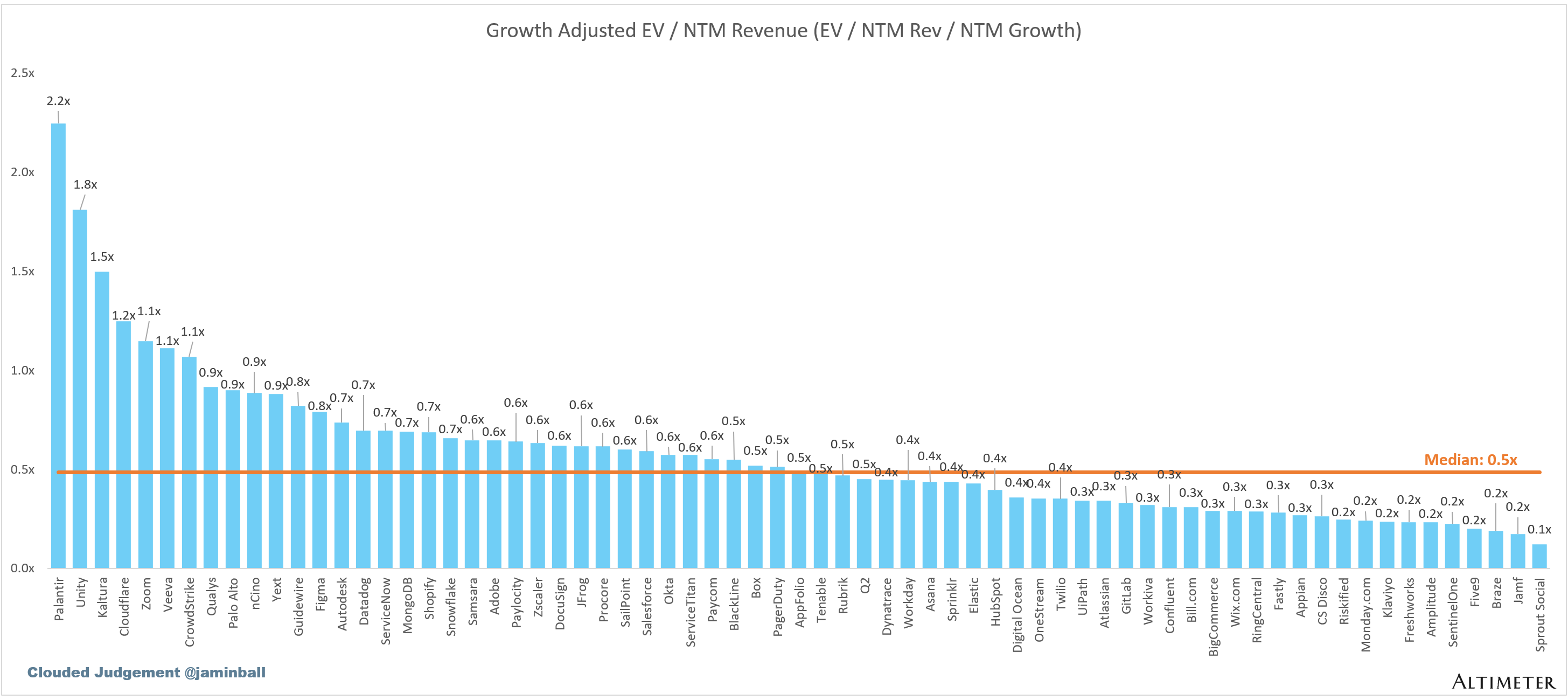
EV / NTM Rev / NTM Growth
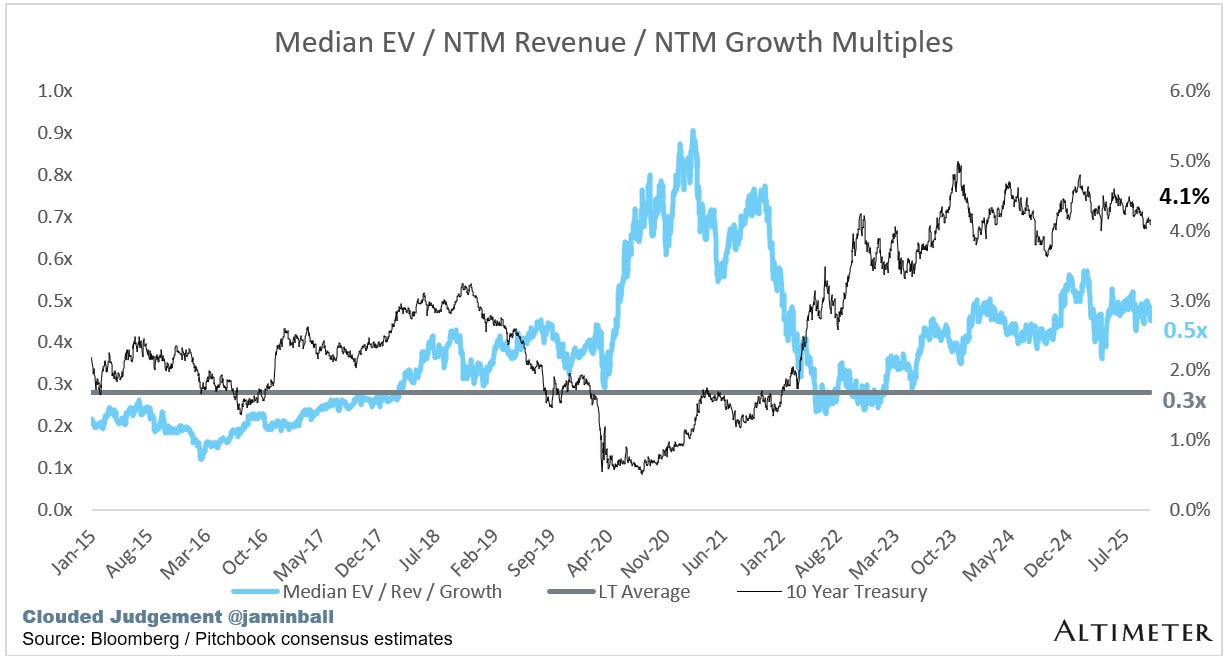
The below chart shows the EV / NTM revenue multiple divided by NTM consensus growth expectations. So a company trading at 20x NTM revenue that is projected to grow 100% would be trading at 0.2x. The goal of this graph is to show how relatively cheap / expensive each stock is relative to its growth expectations.
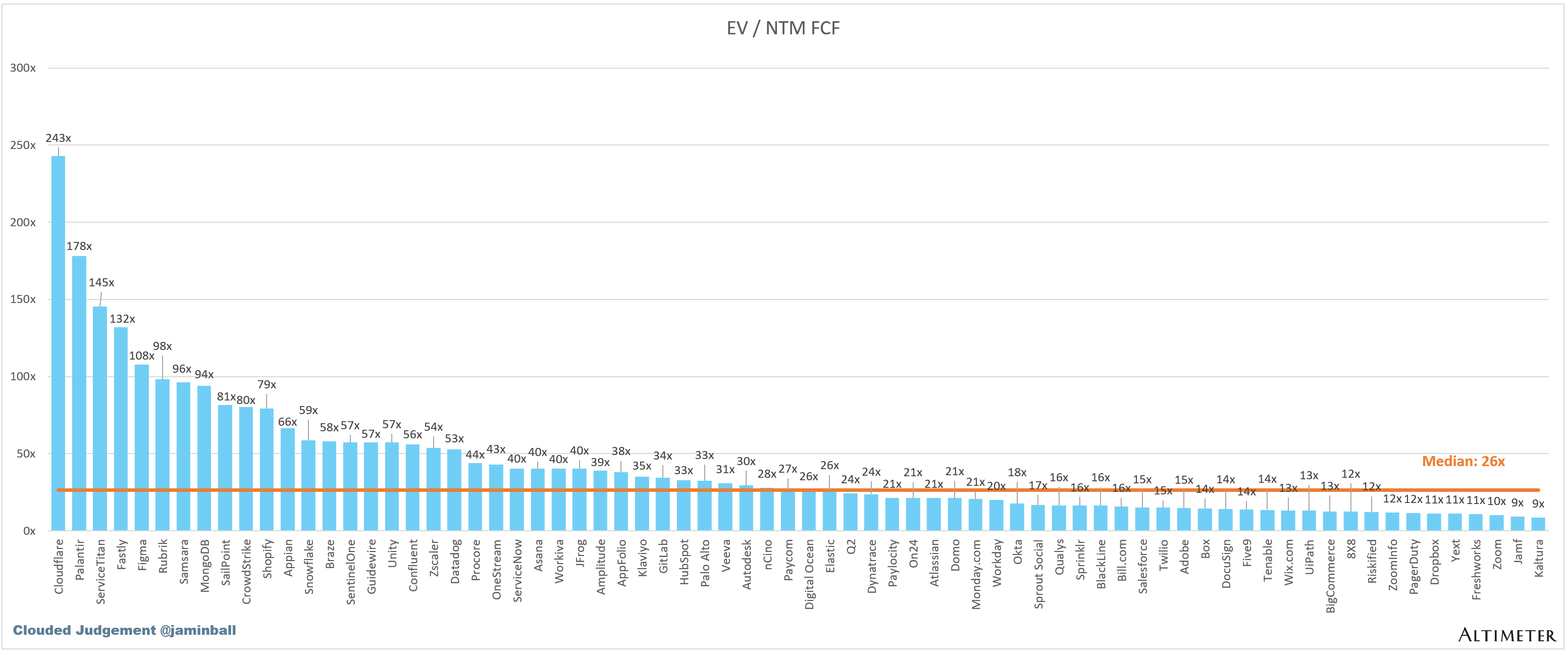
EV / NTM FCF
The line chart shows the median of all companies with a FCF multiple >0x and <100x. I created this subset to show companies where FCF is a relevant valuation metric.
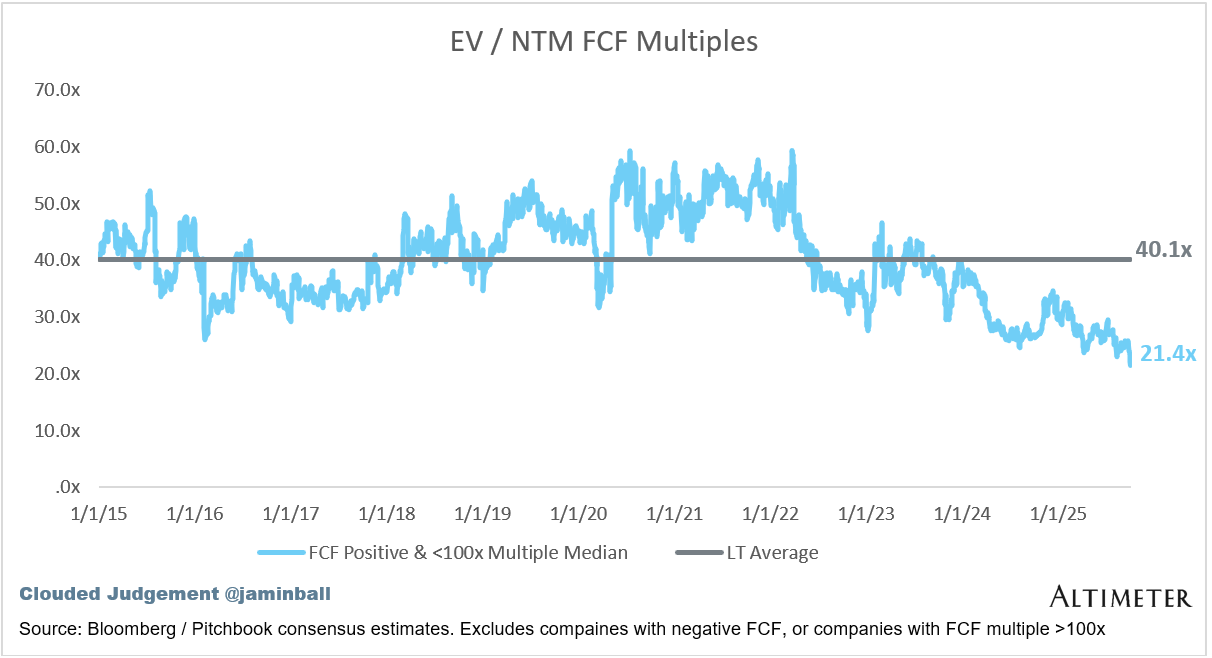
Companies with negative NTM FCF are not listed on the chart
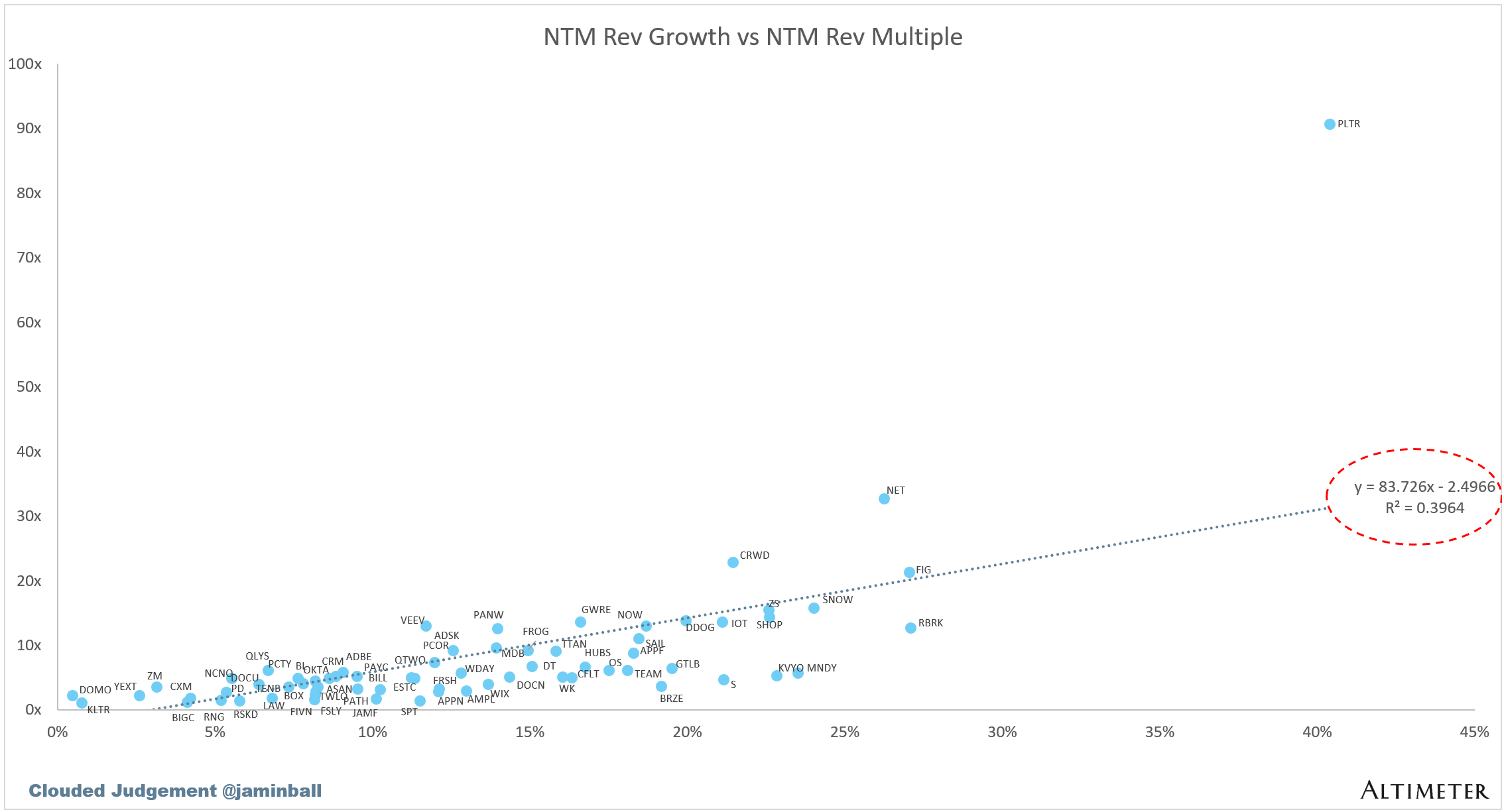
Scatter Plot of EV / NTM Rev Multiple vs NTM Rev Growth
How correlated is growth to valuation multiple?
Operating Metrics
Median NTM growth rate: 12%
Median LTM growth rate: 14%
Median Gross Margin: 76%
Median Operating Margin (2%)
Median FCF Margin: 18%
Median Net Retention: 108%
Median CAC Payback: 32 months
Median S&M % Revenue: 37%
Median R&D % Revenue: 24%
Median G&A % Revenue: 15%
Comps Output
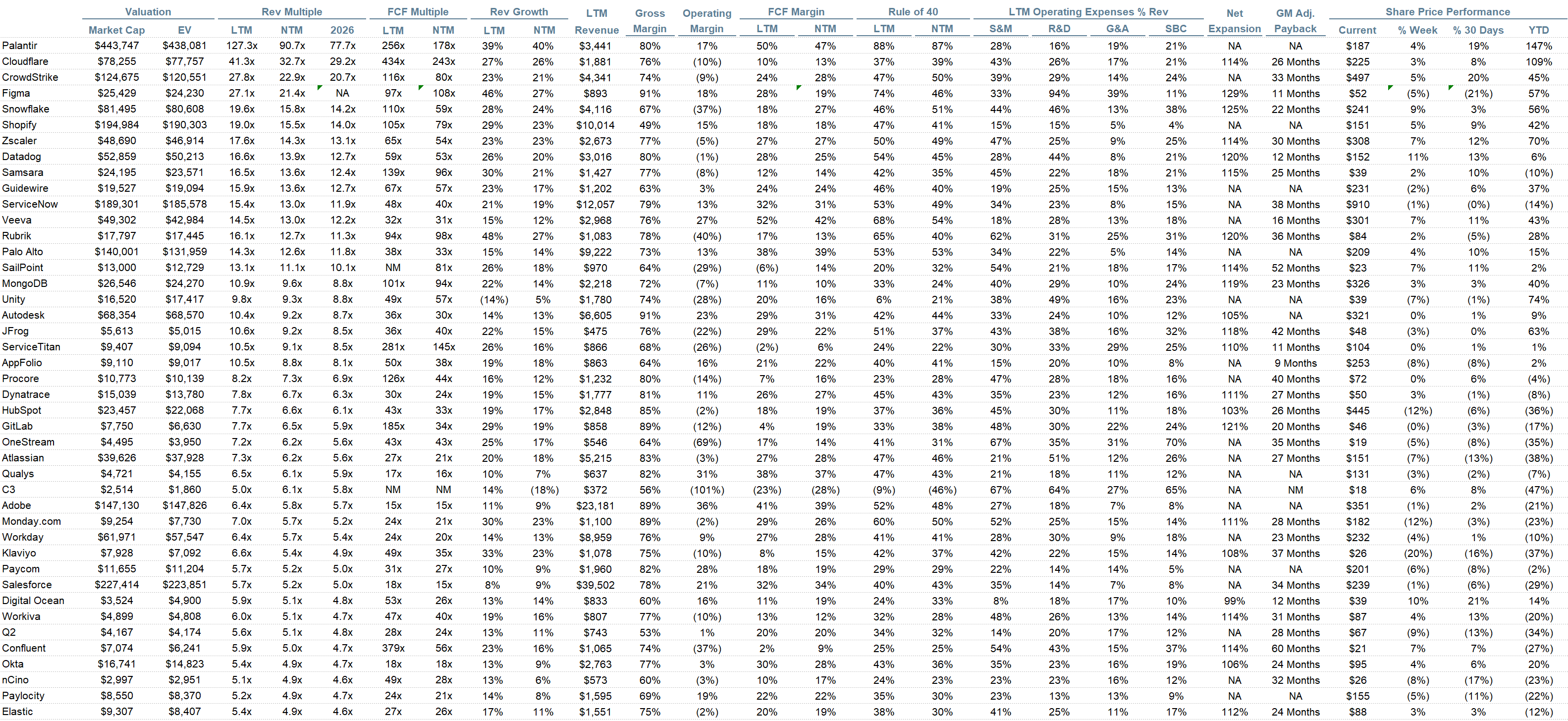
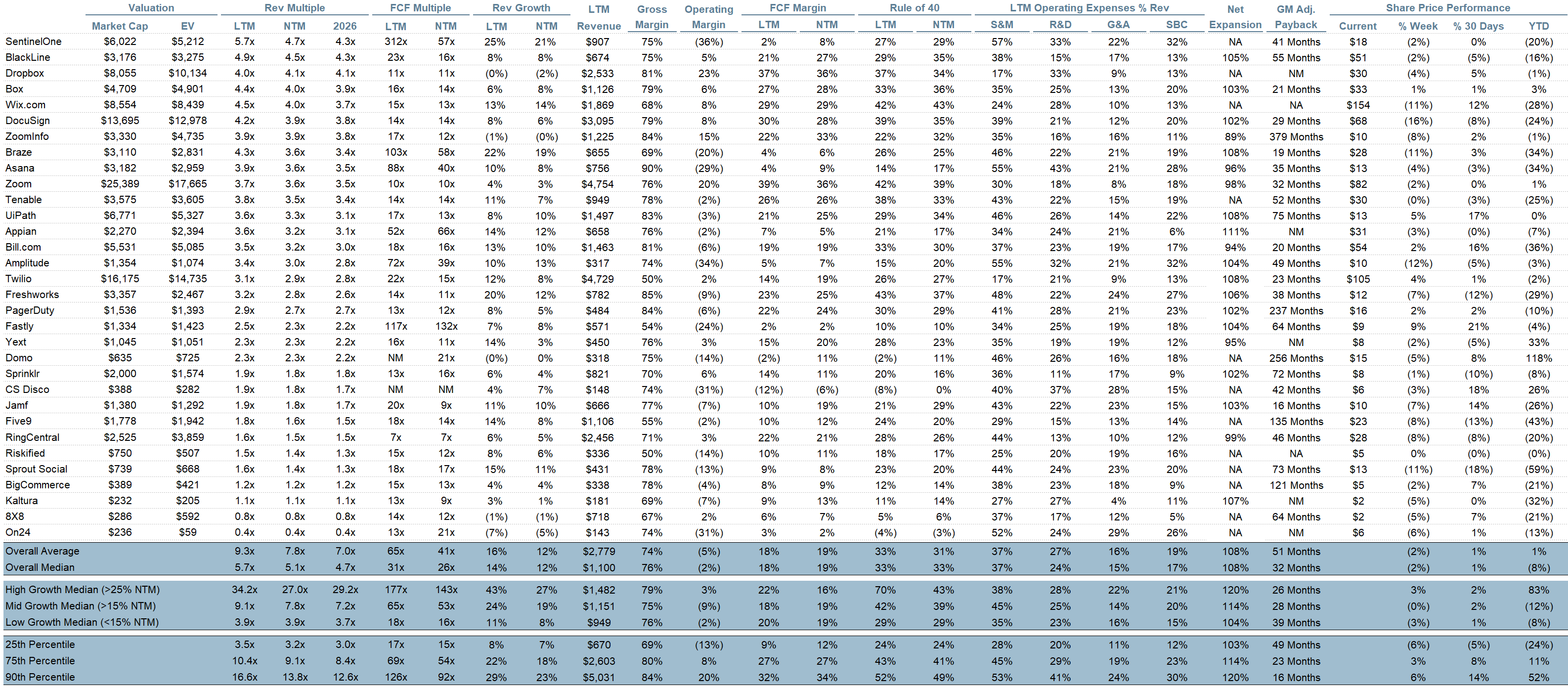
Rule of 40 shows rev growth + FCF margin (both LTM and NTM for growth + margins). FCF calculated as Cash Flow from Operations - Capital Expenditures
GM Adjusted Payback is calculated as: (Previous Q S&M) / (Net New ARR in Q x Gross Margin) x 12. It shows the number of months it takes for a SaaS business to pay back its fully burdened CAC on a gross profit basis. Most public companies don’t report net new ARR, so I’m taking an implied ARR metric (quarterly subscription revenue x 4). Net new ARR is simply the ARR of the current quarter, minus the ARR of the previous quarter. Companies that do not disclose subscription rev have been left out of the analysis and are listed as NA.
Sources used in this post include Bloomberg, Pitchbook and company filings
The information presented in this newsletter is the opinion of the author and does not necessarily reflect the view of any other person or entity, including Altimeter Capital Management, LP (”Altimeter”). The information provided is believed to be from reliable sources but no liability is accepted for any inaccuracies. This is for information purposes and should not be construed as an investment recommendation. Past performance is no guarantee of future performance. Altimeter is an investment adviser registered with the U.S. Securities and Exchange Commission. Registration does not imply a certain level of skill or training. Altimeter and its clients trade in public securities and have made and/or may make investments in or investment decisions relating to the companies referenced herein. The views expressed herein are those of the author and not of Altimeter or its clients, which reserve the right to make investment decisions or engage in trading activity that would be (or could be construed as) consistent and/or inconsistent with the views expressed herein.
This post and the information presented are intended for informational purposes only. The views expressed herein are the author’s alone and do not constitute an offer to sell, or a recommendation to purchase, or a solicitation of an offer to buy, any security, nor a recommendation for any investment product or service. While certain information contained herein has been obtained from sources believed to be reliable, neither the author nor any of his employers or their affiliates have independently verified this information, and its accuracy and completeness cannot be guaranteed. Accordingly, no representation or warranty, express or implied, is made as to, and no reliance should be placed on, the fairness, accuracy, timeliness or completeness of this information. The author and all employers and their affiliated persons assume no liability for this information and no obligation to update the information or analysis contained herein in the future.
Jamin brings up what may be the defining question of our move to a more AI driven world; how do we marry probabilistic optimization with deterministic requirements? This in turn opens up a bigger can of worms; has the world changed beyond the capabilities of the deterministic systems we have come to know. In an environment of fast-changing operational variables how do you still get the package there on time or the correct care to the patient? In a nod to Charlie Munger, perhaps you turn the question around, from "train on how we do things" to "how do I optimize how we do things right now to get the desired result". Maybe in many cases "how we do things" reflects a bygone era that holds you back, with dynamic optimization with in guardrails the more successful strategy.
I would love to know how you get access to the Altimeter charts? Also, this newsletter was a big part of my board deck at Smartsheet :) thank you!