

Every week I’ll provide updates on the latest trends in cloud software companies. Follow along to stay up to date!
Monopoly Money
I want to write this week about a topic that’s been bugging me recently. It’s an irrational (in my opinion…) behavior that’s starting to emerge in earlier stage startup land more and more. The challenge is - I can see how we are getting to an irrational end state with a rational starting point… And it all comes down to how employees view and value startup equity. So this post is meant for all of the employees evaluating different offers from startups. Let me set the stage with a hypothetical conversation
Founder: “I need to raise at the highest valuation possible. And after I do, I need to raise again in 6 months at an even higher valuation.”
Me: “Why?”
Founder: “Because that’s how I will attract and hire the best talent”
Me: “Why? Wouldn’t new hires want a lower valuation for more upside?”
Founder: “No. All they care about is the dollar value of the equity package I’m offering. If they have an equity offer from [Company X] that is worth $10m, they want an equity package from me worth $10m. And $10m is much easier to offer if my valuation is $3b than if it was $500m. The dilution is much different.”
Me: “So to play this example to it’s extreme, you’re saying someone would rather have $10m in equity of your company at a valuation of $3b, then $5m of equity in your company at a $500m valuation? All else being exactlyy equal?”
Founder: “Yes. Because $10m is greater than $5m.”
Me: “Really?!? They’re really not thinking about the upside from the entry valuation, and what the equity could be worth at exit? They’re only looking at the equity value at present? And on top of that, they’re not realizing they’re getting OPTIONS that are WORTHLESS below the issue / exercise price? So the higher valuation actually increases the odds they get nothing??”
Founder: “Yes. I know. It makes no sense. But this is what the market is right now. So if I want to hire the best people, I have to give them equity packages that have a higher present dollar value, and doing that from a low valuation will be crippling from a dilution standpoint. So I have to keep raising at higher and higher valuations to be competitive on talent.”
I can’t tell you how often I’ve had this conversation in the last couple months…And it’s driving me crazy. We saw this movie in 2021. Higher valuations do not mean less risk. Startups have paper marks (meaning the stock isn’t liquid, it can’t be sold to the market at that price today, you have to wait for an exit).
So many investors have different incentives. Often times they’re buying deep out of the money call options - tht when they hit, they hit in a BIG way. But a key point of that analogy is the “deeply out of the money” part… You can’t value the dollar value of your equity at the “out of the money” price… The true “value” of your package is probably much lower. And just like in 2021, when companies can’t perform and hit business metrics (ie revenue and profits) to justify the paper marks, employees across the board realize their equity is underwater and they leave in droves. It’s a cycle that will surely repeat itself.
So for founders - be careful of playing this game. I realize you probably have to until employee behavior changes, but it’s a very high risk high reward game. Investors can play it because our returns aren’t evenly distributed. We play by the power law. Most portfolio returns will be subpar, and a few will be home runs. As a founder, you have one company.
And for employees considering joining a startup. Think more about the % you are getting, and what that % could be worth at exit (ie how big could this company get, multiply that % by the outcome). That’s really what you’re playing for. If you’re joining a Meta, Microsoft, or very late stage private company, then yes, your equity is closer to “cash” as the equity can be exchanged for cash easily once it vests.
In many ways it’s “irrational” to join an early stage startup. Most fail (meaning the equity is worth nothing), and the cash compensation almost never rivals what you can get from a large public company or late stage “quasi-public” company (because young startups don’t have the balance sheet to pay large salaries). You join the startup because you love that environment, you love the grind, you love the 0-1 phase, and on top of that the potential upside from the equity can be life changing. HOWEVER - if the starting point of that equity is artificially high (ie the company raised at a crazy high valuation), then the last part of the equation (the equity upside) becomes more muted. Sure, it may “appear” to be worth more at entry, but the upside isn’t there. If you want the stability of a steady income, just go join a mega cap tech company. If you want to change the world, go to a startup :)
Quarterly Reports Summary
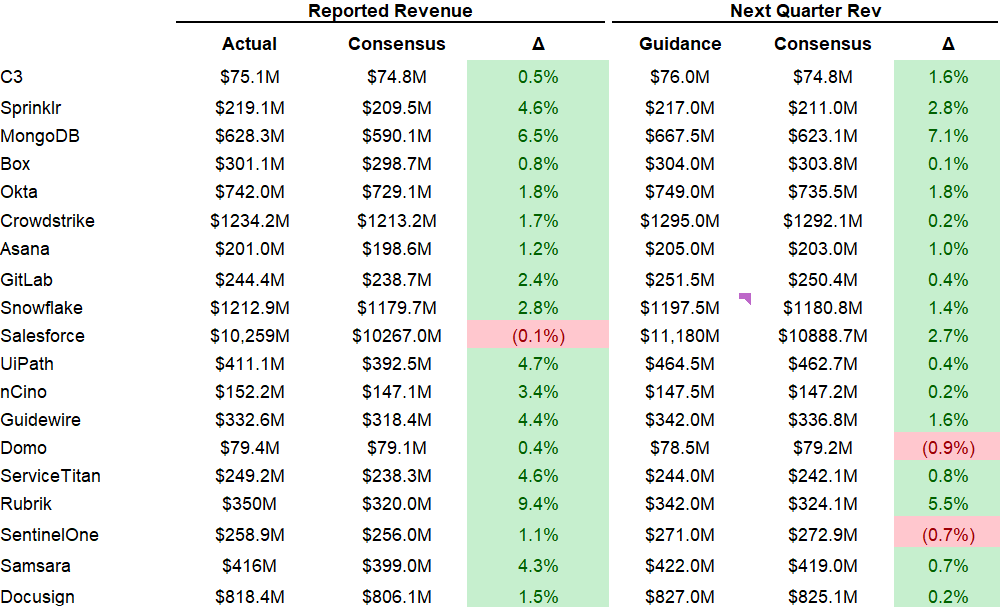
Top 10 EV / NTM Revenue Multiples
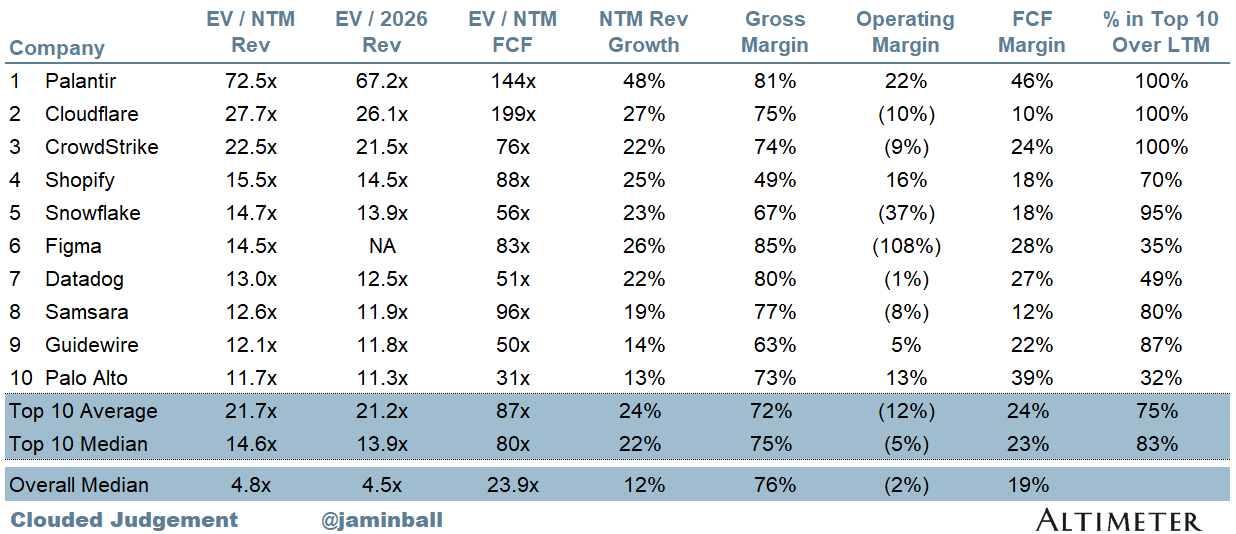
Top 10 Weekly Share Price Movement
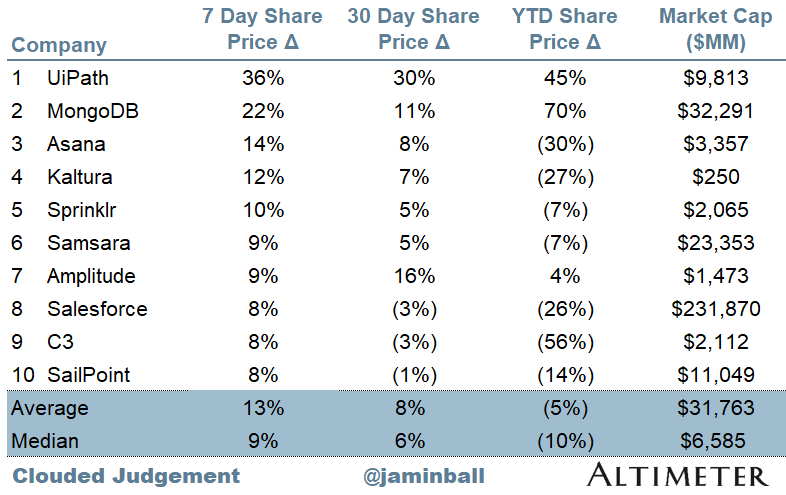
Update on Multiples
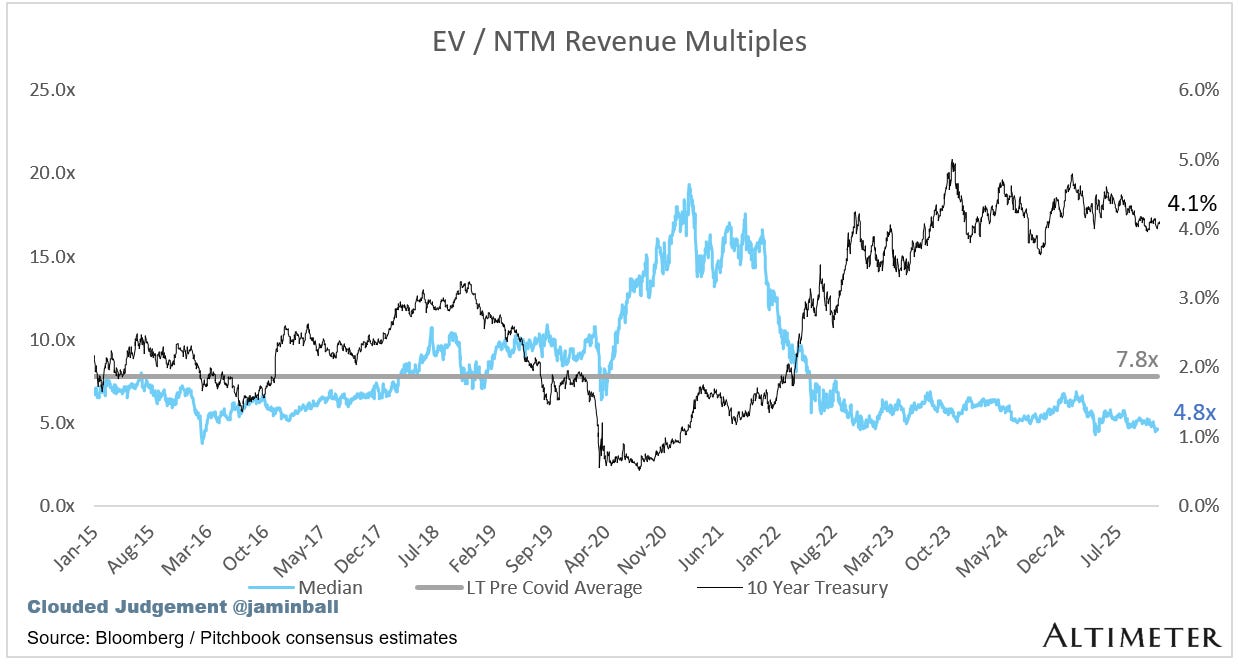
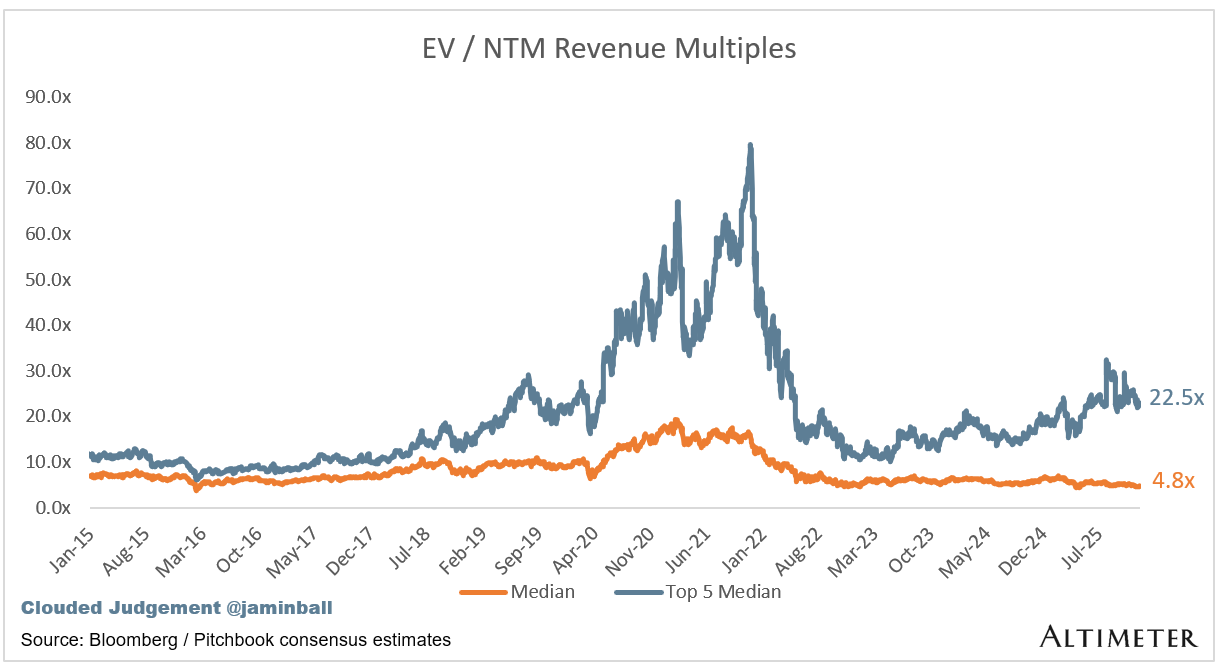
SaaS businesses are generally valued on a multiple of their revenue - in most cases the projected revenue for the next 12 months. Revenue multiples are a shorthand valuation framework. Given most software companies are not profitable, or not generating meaningful FCF, it’s the only metric to compare the entire industry against. Even a DCF is riddled with long term assumptions. The promise of SaaS is that growth in the early years leads to profits in the mature years. Multiples shown below are calculated by taking the Enterprise Value (market cap + debt - cash) / NTM revenue.
Overall Stats:
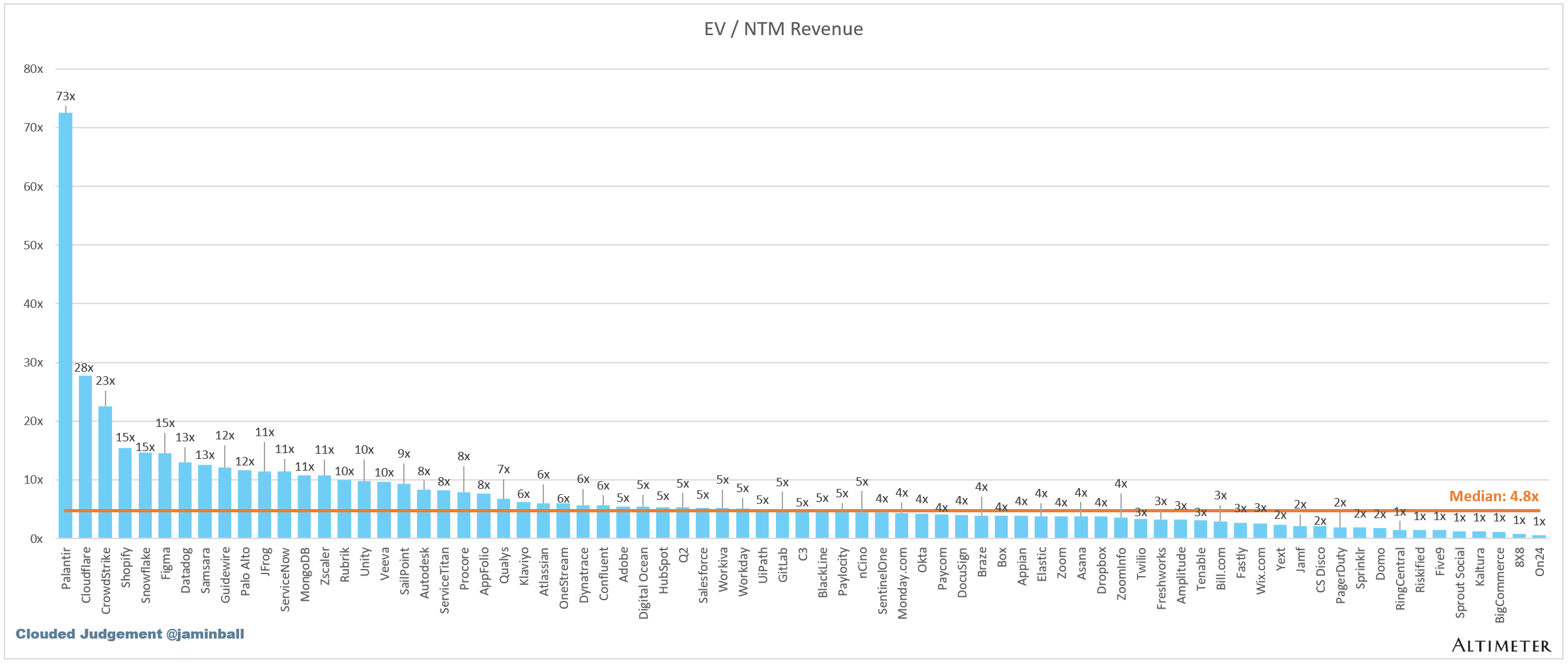
Overall Median: 4.8x
Top 5 Median: 22.5x
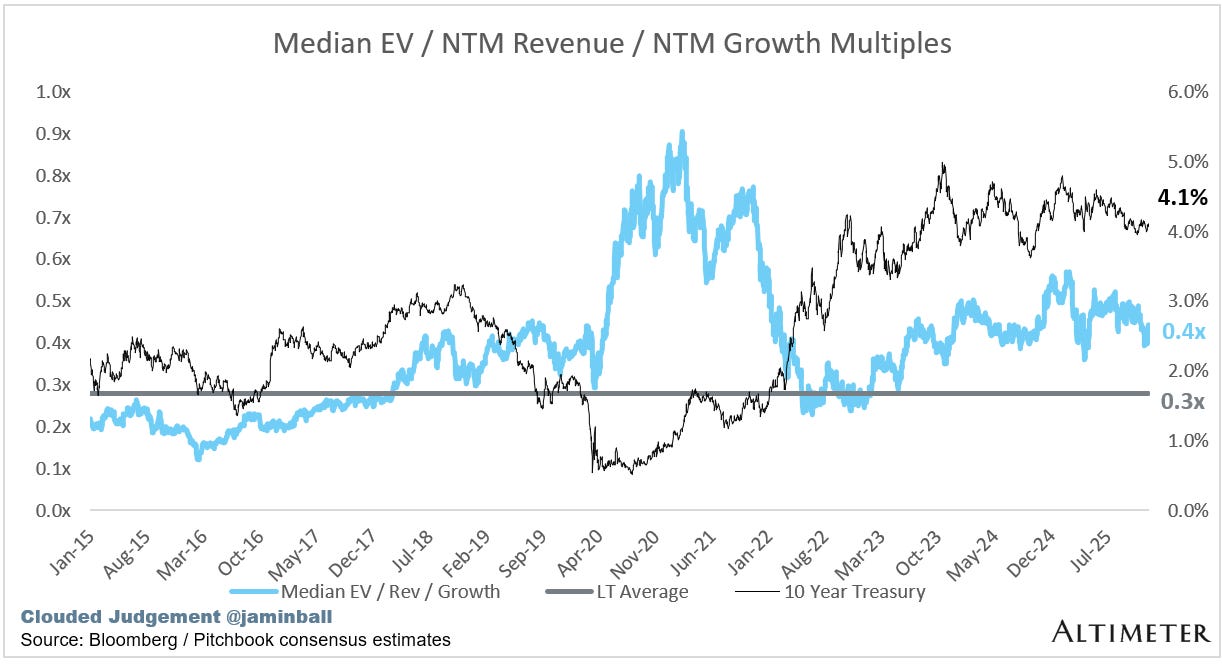
10Y: 4.1%
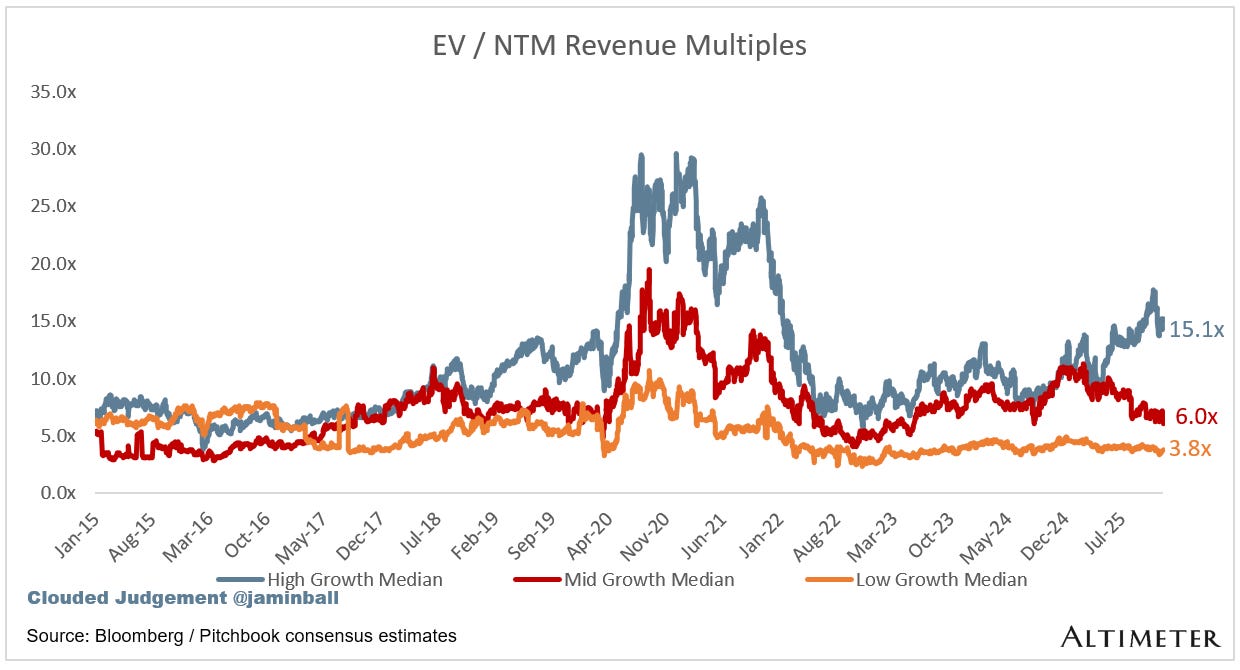
Bucketed by Growth. In the buckets below I consider high growth >22% projected NTM growth, mid growth 15%-22% and low growth <15%. I had to adjusted the cut off for “high growth.” If 22% feels a bit arbitrary, it’s because it is…I just picked a cutoff where there were ~10 companies that fit into the high growth bucket so the sample size was more statistically significant
High Growth Median: 15.1x
Mid Growth Median: 6.0x
Low Growth Median: 3.8x
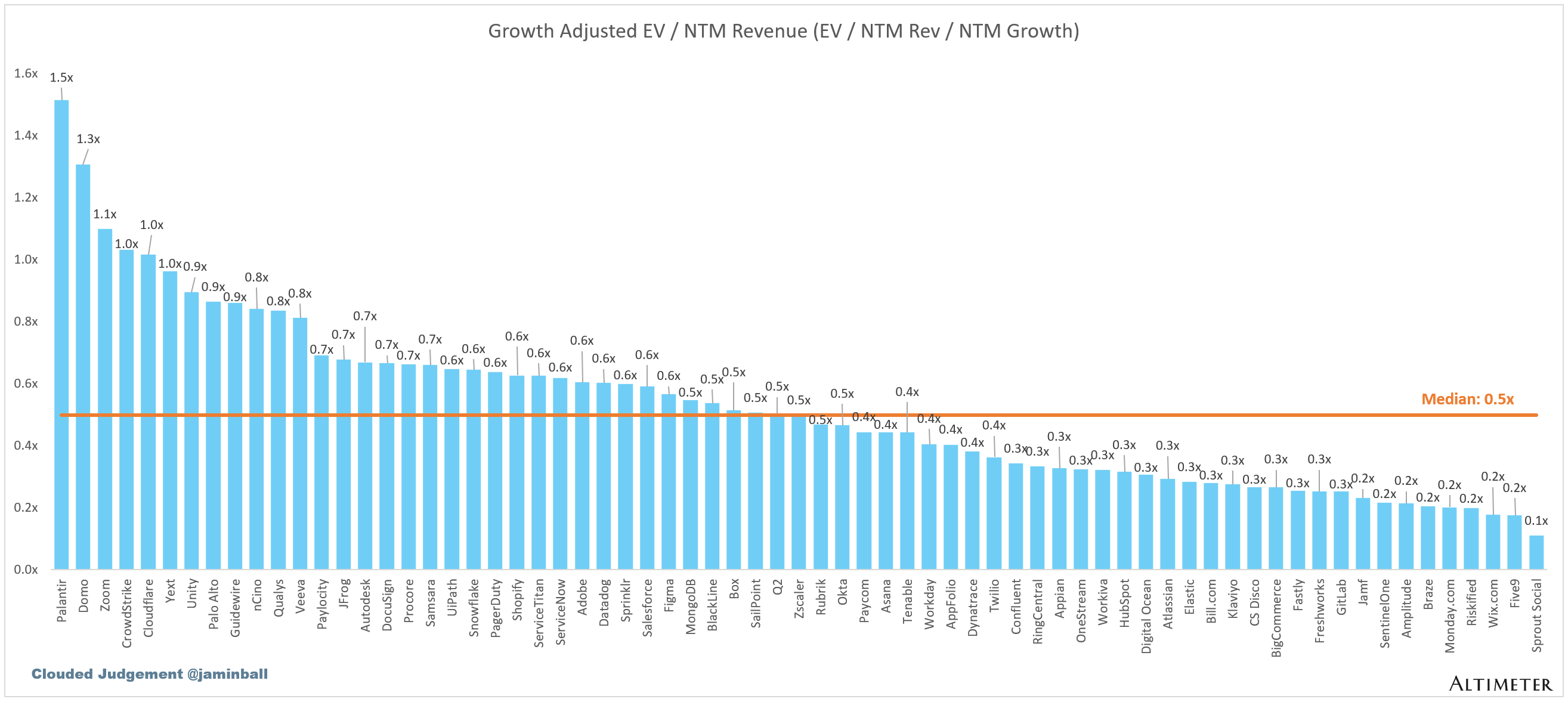
EV / NTM Rev / NTM Growth
The below chart shows the EV / NTM revenue multiple divided by NTM consensus growth expectations. So a company trading at 20x NTM revenue that is projected to grow 100% would be trading at 0.2x. The goal of this graph is to show how relatively cheap / expensive each stock is relative to its growth expectations.
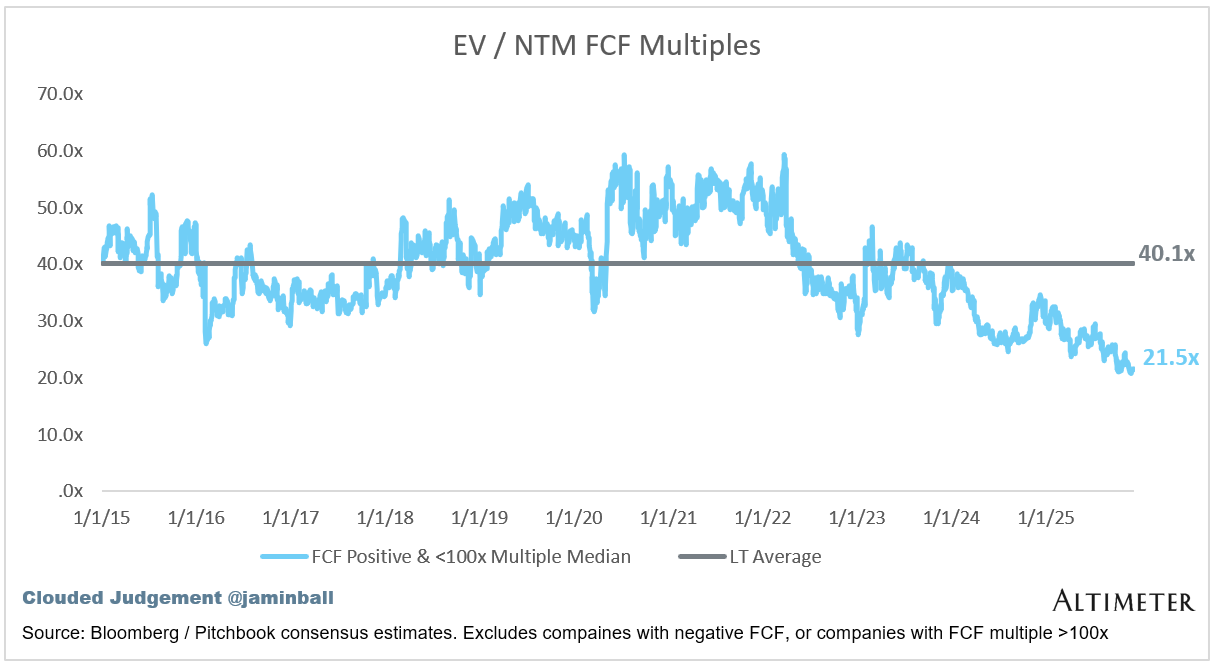
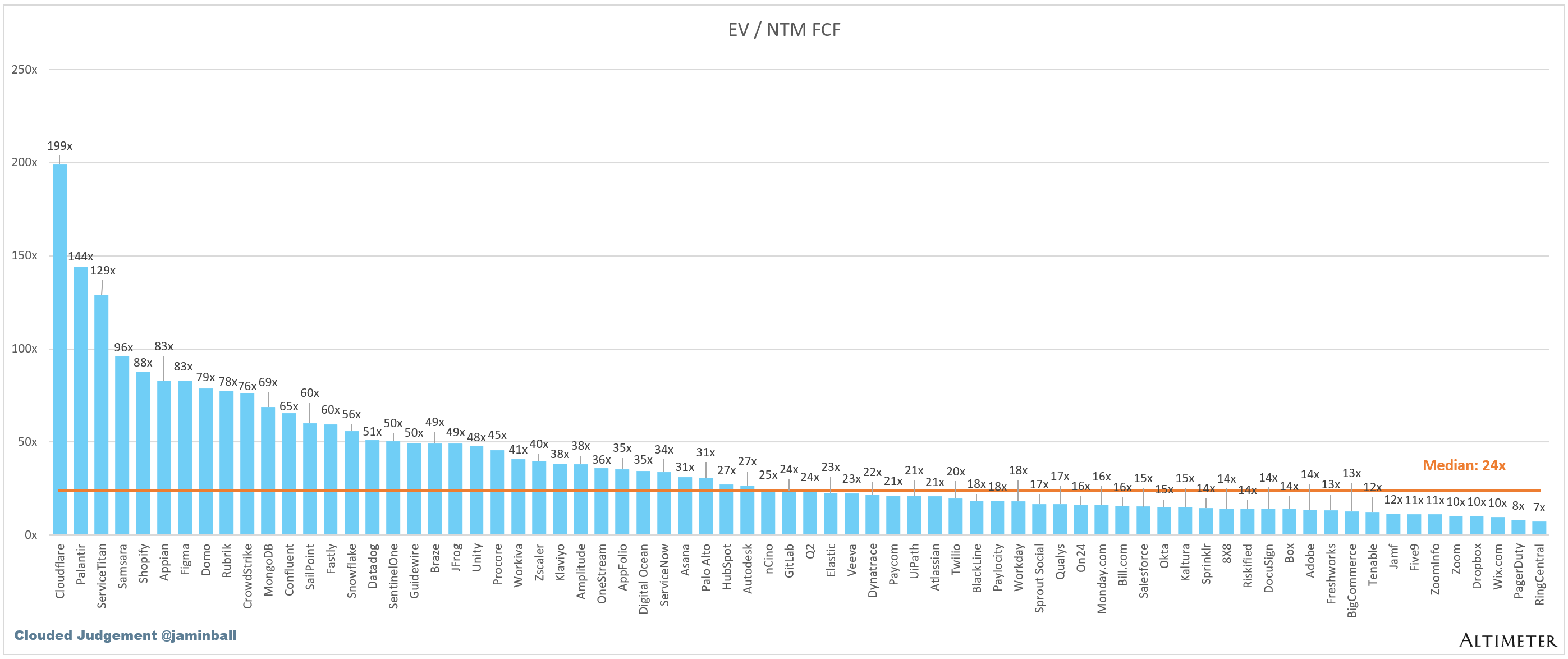
EV / NTM FCF
The line chart shows the median of all companies with a FCF multiple >0x and <100x. I created this subset to show companies where FCF is a relevant valuation metric.
Companies with negative NTM FCF are not listed on the chart
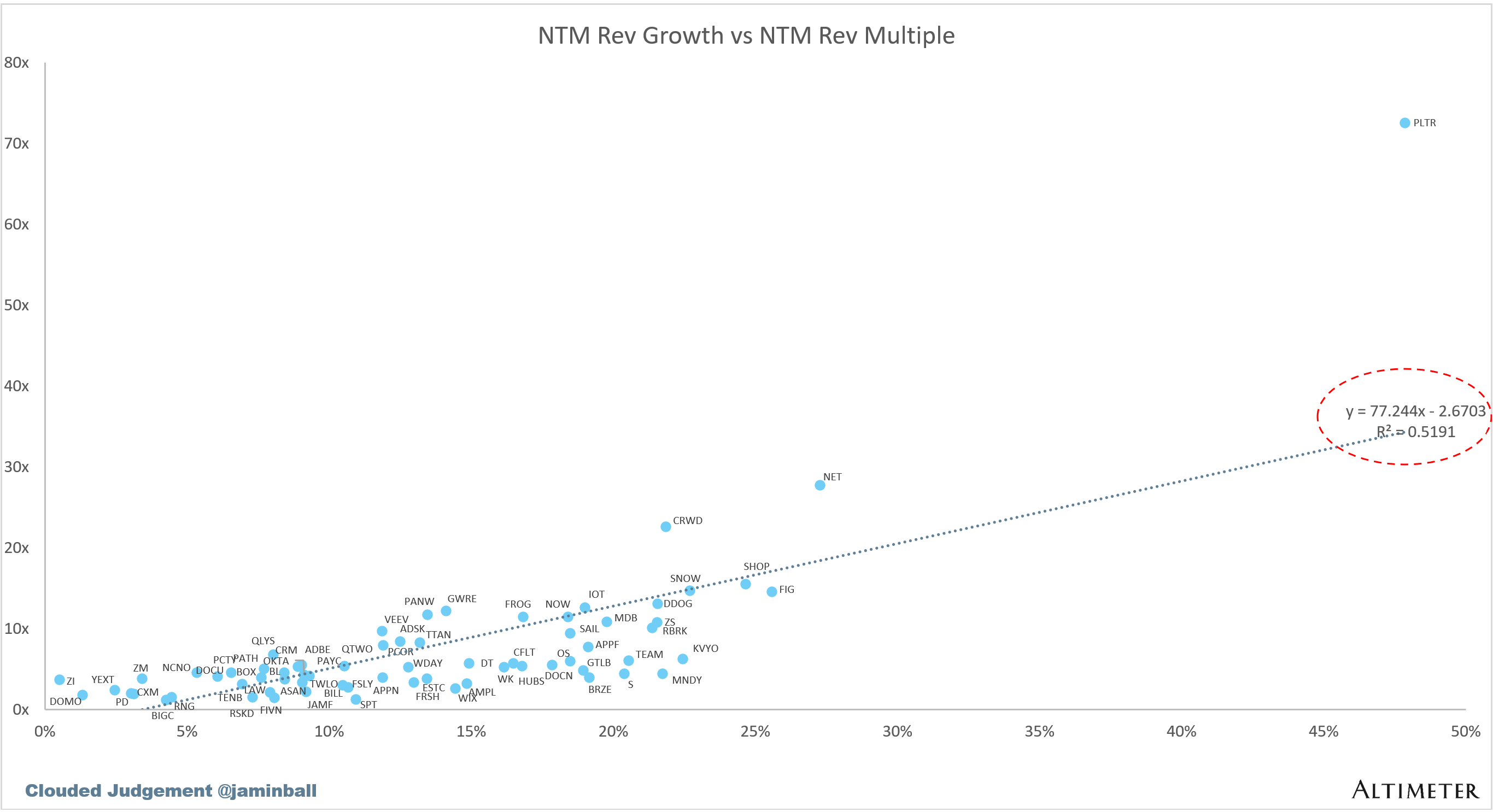
Scatter Plot of EV / NTM Rev Multiple vs NTM Rev Growth
How correlated is growth to valuation multiple?
Operating Metrics
Median NTM growth rate: 12%
Median LTM growth rate: 14%
Median Gross Margin: 76%
Median Operating Margin (2%)
Median FCF Margin: 19%
Median Net Retention: 108%
Median CAC Payback: 35 months
Median S&M % Revenue: 37%
Median R&D % Revenue: 23%
Median G&A % Revenue: 15%
Comps Output
Rule of 40 shows rev growth + FCF margin (both LTM and NTM for growth + margins). FCF calculated as Cash Flow from Operations - Capital Expenditures
GM Adjusted Payback is calculated as: (Previous Q S&M) / (Net New ARR in Q x Gross Margin) x 12. It shows the number of months it takes for a SaaS business to pay back its fully burdened CAC on a gross profit basis. Most public companies don’t report net new ARR, so I’m taking an implied ARR metric (quarterly subscription revenue x 4). Net new ARR is simply the ARR of the current quarter, minus the ARR of the previous quarter. Companies that do not disclose subscription rev have been left out of the analysis and are listed as NA.
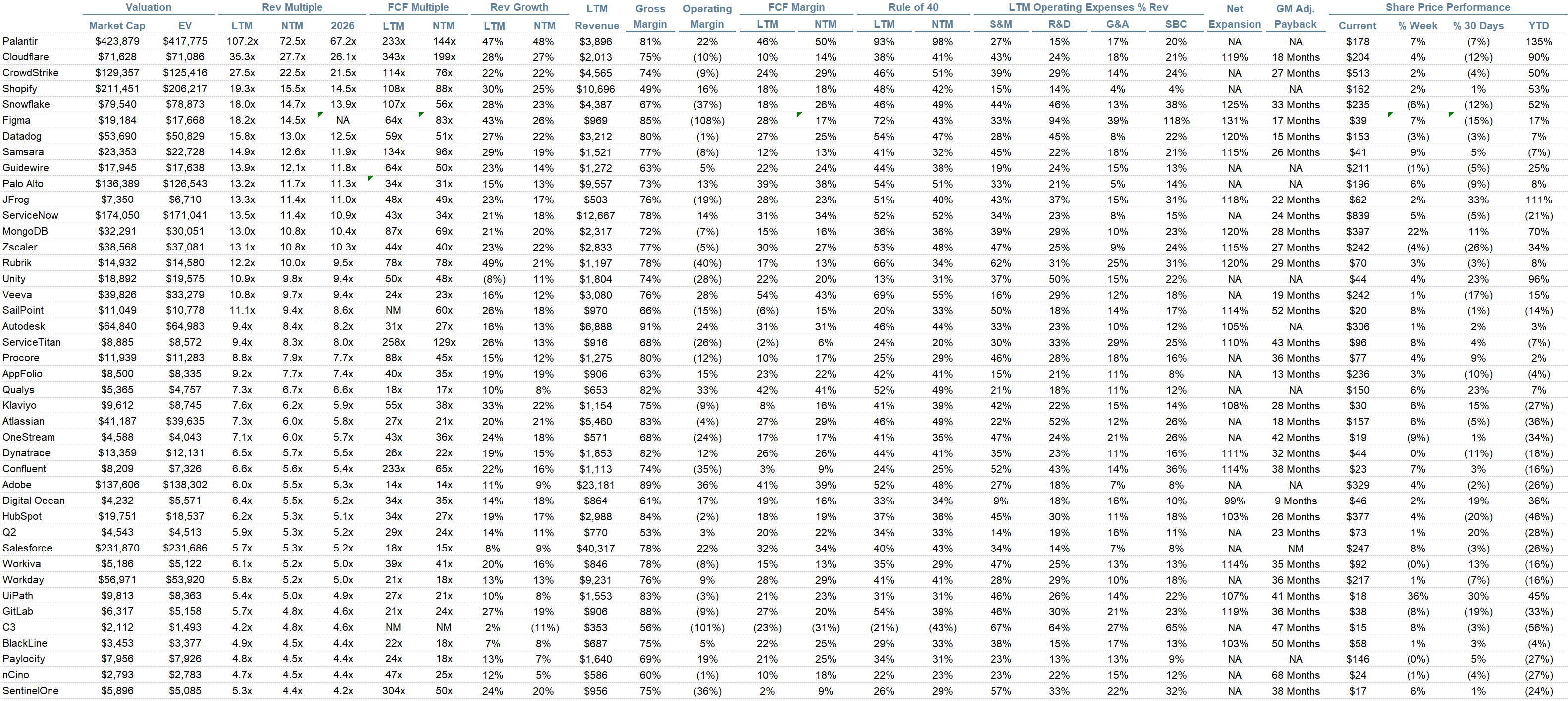
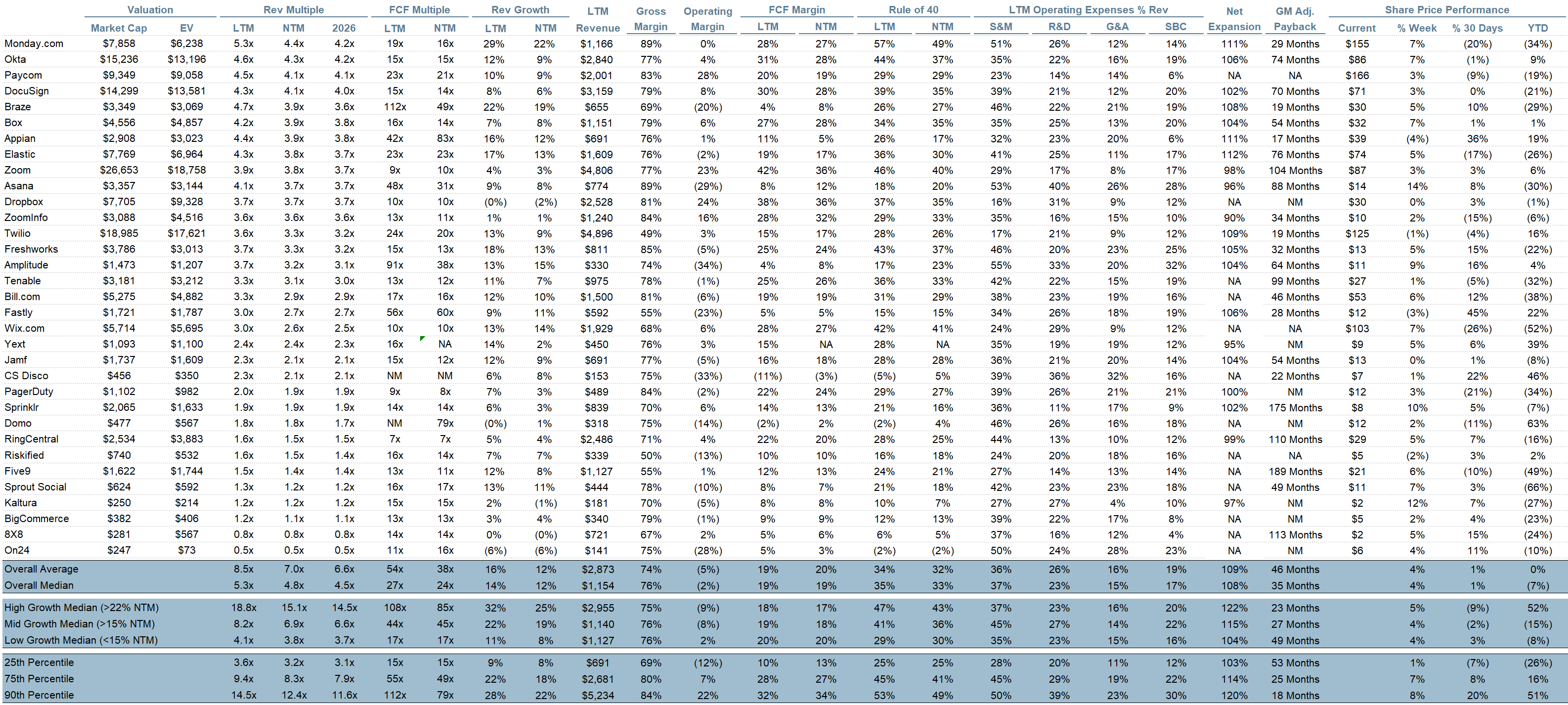
Sources used in this post include Bloomberg, Pitchbook and company filings
The information presented in this newsletter is the opinion of the author and does not necessarily reflect the view of any other person or entity, including Altimeter Capital Management, LP (”Altimeter”). The information provided is believed to be from reliable sources but no liability is accepted for any inaccuracies. This is for information purposes and should not be construed as an investment recommendation. Past performance is no guarantee of future performance. Altimeter is an investment adviser registered with the U.S. Securities and Exchange Commission. Registration does not imply a certain level of skill or training. Altimeter and its clients trade in public securities and have made and/or may make investments in or investment decisions relating to the companies referenced herein. The views expressed herein are those of the author and not of Altimeter or its clients, which reserve the right to make investment decisions or engage in trading activity that would be (or could be construed as) consistent and/or inconsistent with the views expressed herein.
This post and the information presented are intended for informational purposes only. The views expressed herein are the author’s alone and do not constitute an offer to sell, or a recommendation to purchase, or a solicitation of an offer to buy, any security, nor a recommendation for any investment product or service. While certain information contained herein has been obtained from sources believed to be reliable, neither the author nor any of his employers or their affiliates have independently verified this information, and its accuracy and completeness cannot be guaranteed. Accordingly, no representation or warranty, express or implied, is made as to, and no reliance should be placed on, the fairness, accuracy, timeliness or completeness of this information. The author and all employers and their affiliated persons assume no liability for this information and no obligation to update the information or analysis contained herein in the future.
This behavior has made the risk-reward equation in startupland a joke for experienced operators.
This is SUCH a great observation. Crazy that would-be new hires are attracted to higher valuations.
The problems won’t be far behind. Most that try to maximize valuation and succeed will very soon have screwed up cap tables that the next investor won’t want to put money in. Even if the business otherwise looks great. Because the last round and preferences just make jt a tougher bet down the line.
It’s a thorny issue — needs to be better education for the talent looking for gigs.