

Every week I’ll provide updates on the latest trends in cloud software companies. Follow along to stay up to date!
Own the Interaction Layer
living on a razors edge - balance of doing too little and missing the moment, and doing too much and drowning
Last year I wrote an article about how the front door to systems of record were evolving. I think a better title would have been something about how the “interaction layer” is evolving. The general idea of the post is that when we saw the internet arise it ended up “layering” platforms that used to own the customer interaction layer (and turned “front door” applications into middleware). The other point of the post is that whoever owns the interaction layer (ie the place where the end user takes actions) ends up capturing most of the profits. The example in that post was OTAs became the interaction layer for travel (in the age of the internet) and pushed down the GDS systems to middleware. This last week we started to really see a tangible example of how this may play out with AI, and ironically travel was at the center again!
What’s happened is that general purpose personal agents like Instinct, Muse, Grok Bot, etc have taken off. The last few weeks they’ve all gone vertical. For anyone who hasn’t tried one of these, you should! They’re quite powerful and cool. The idea of all of them is similar - a single place to get work done on your behalf. Receive a healthcare bill in the mail? Simply take a picture of it, send it to you personal agent, and ask it to pay it. Need to book a haircut? Ask your agent to go online and reserve you a time in the morning that works with your calendar. The agent handles the rest. It gathers context from your calendar, spins up a virtual browser in a VM, and completes the task.
Then this week I saw two announcements:
Expedia announced a partnership with Muse (Meta’s personal assistant product).
Both are quite interesting! Let’s take a look at the first (Expedia). In the early days of the internet, the OTAs (ie Expedia, Booking, etc) took over the interaction layer and became the place travel was booked. GDS platforms got squeezed as they were the interaction layer pre internet, and then became middleware. Are personal assistants now doing to OTAs what OTAs did to GDS systems?? If all I do to book travel is go to my personal assistant, then the OTAs are reduced to commodity middleware. In this scenario, all of the profits will aggregate at the interaction layer - the personal assistant. The market may be pricing this in - Expedia was down almost ~10% this week AFTER announcing this partnership with Muse. My guess - whether it’s travel (or many forms of commerce) the battle for owning the interaction layer is about to get super intense.
Then there was the Amazon announcement. They took the opposite approach! They don’t want to get reduced to middleware. I could say to Muse “I’m running low on laundry detergent, go on Amazon and buy more of the same detergent I always buy.” In this case, I never have to go to Amazon. My assistant just purchases it for me. But by doing this, Amazon looses my eyeballs. Can’t sell ads. They don’t want to get reduced to middleware, so they’re fighting it. They want to continue owning the interaction layer.
In my opinion - fighting this change is a loosing battle. The interaction layer aggregating around personal assistants feels inevitable. Because what will almost certainly happen - “challengers” will embrace personal assistant agents, and “incumbents” will fight it. Let’s take an example of Uber Eats vs Doordash. Doordash is the dominant incumbent. They want to keep owning the interaction layer. BUT - every other challenger will want to catch up on market share. They don’t have the dominant market position. They’re playing behind. And it will be very easy for them to view AI assistants as a way to gain ground on market share. The challengers will embrace, the incumbents will cede market share as more and more food delivery is ordered through an assistant, and eventually the incumbents will be forced to adopt personal assistants (but at a later time, with inopportune structures).
This cycle feels so inevitable. And it begs the question - how many companies / products today own the interaction layer that are at risk of being disintermediated? I bet the list is longer than most think.
For founders - owning the interaction layer will be incredibly important!
One other side note - as I was writing this, I started to realize how many businesses rely on consumers being lazy. Think about insurance - how often have I received a bill where the out of pocket was higher than expected. Or certain procedures wasn’t deemed “covered.” What I could do is get on the phone for 5 hours, bang my head against the wall sitting on hold, to talk to a representative to figure out the bill. My guess is I have lots of wasted money I paid out of pocket that I didn’t have to. But I was just too lazy to spend the time. I valued my time greater than the expected savings. BUT - this completely flips with personal ai agents. I can explore all of this with zero time. There are so many other examples of this. The subscription economy basically runs on “churn that should happen but doesn’t.” Could be a streaming service I forgot to cancel. Agents can simply scan my credit card bills, see what I’m not using, and go through the cancel flow themselves. Or any kind of insurance product. I’ve had the same car insurance for decades. I’ve never price shopped. Too much of a hassle for unknown savings. What if I asked my agent to shop around every 6 months and always get met the same coverage for the cheapest price? Now repeat for home insurance, internet or cable plans, cell phone service provider, etc. The possibilities become endless! So many businesses could come under threat if the “consumer laziness” goes away.
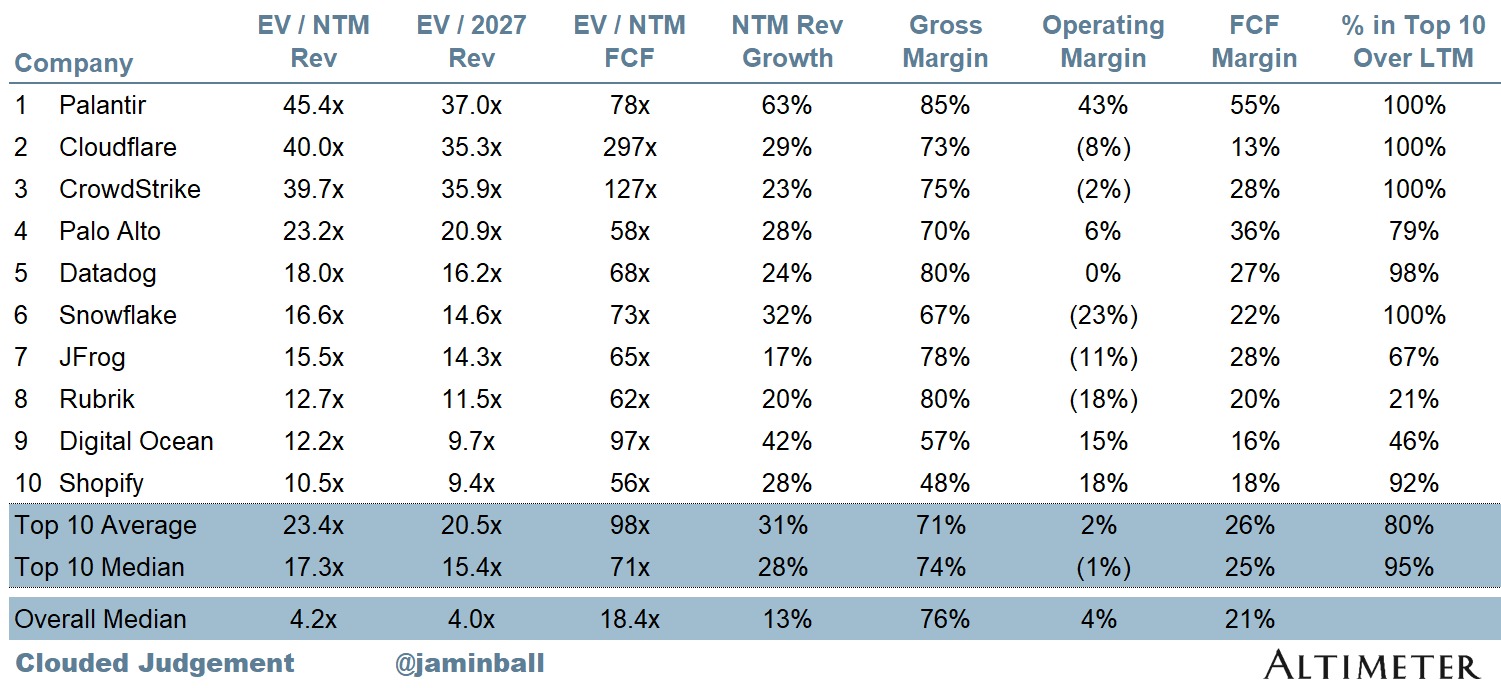
Top 10 EV / NTM Revenue Multiples
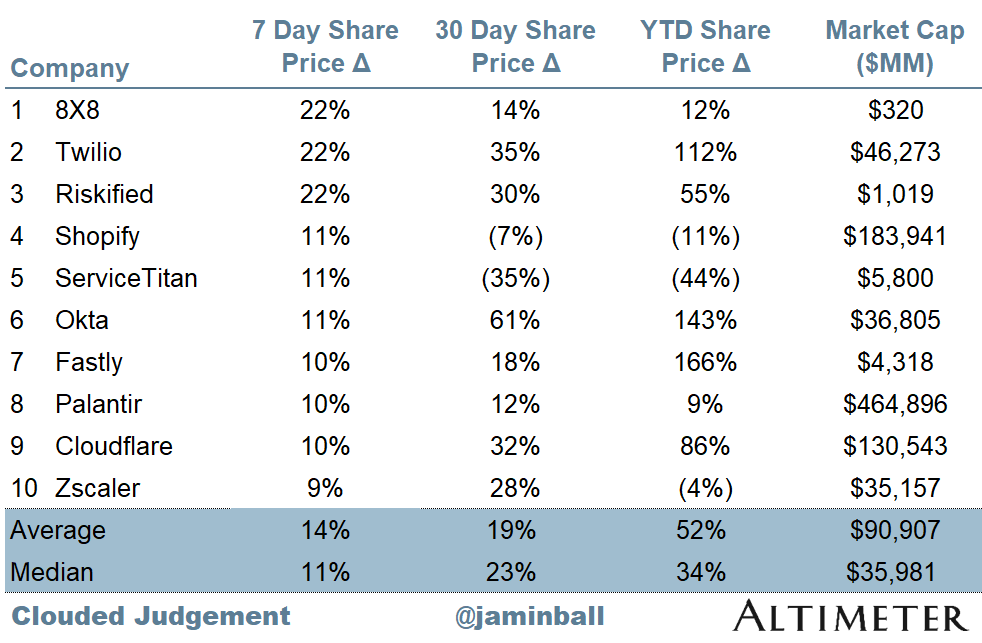
Top 10 Weekly Share Price Movement
Update on Multiples
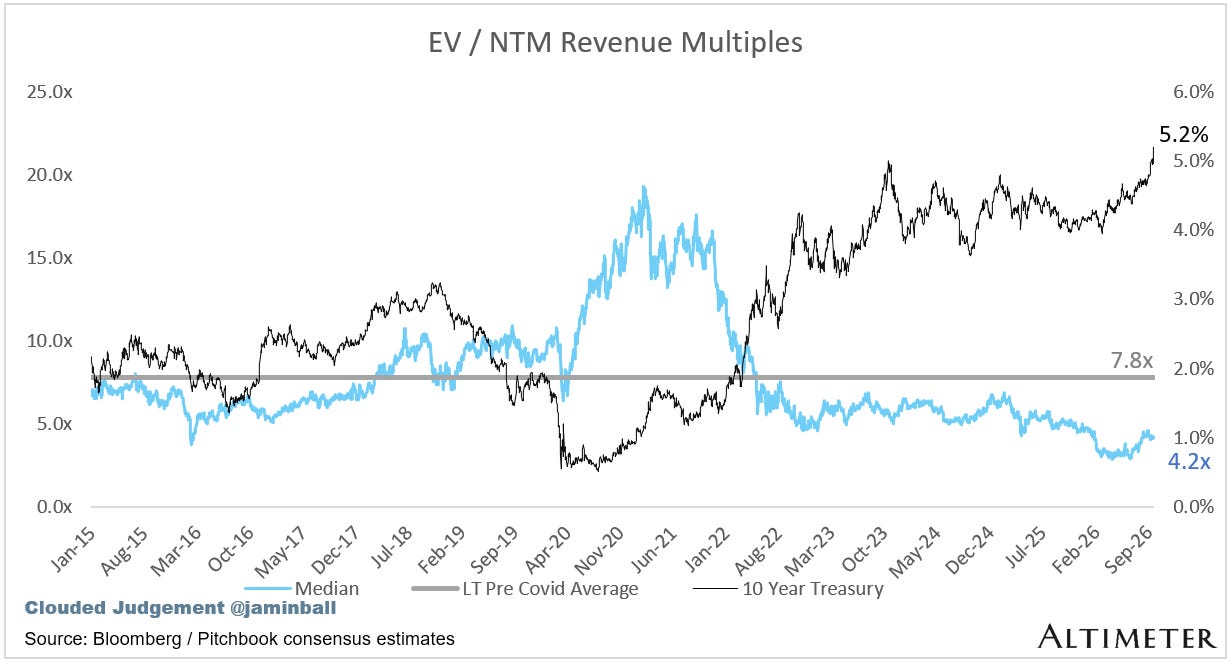
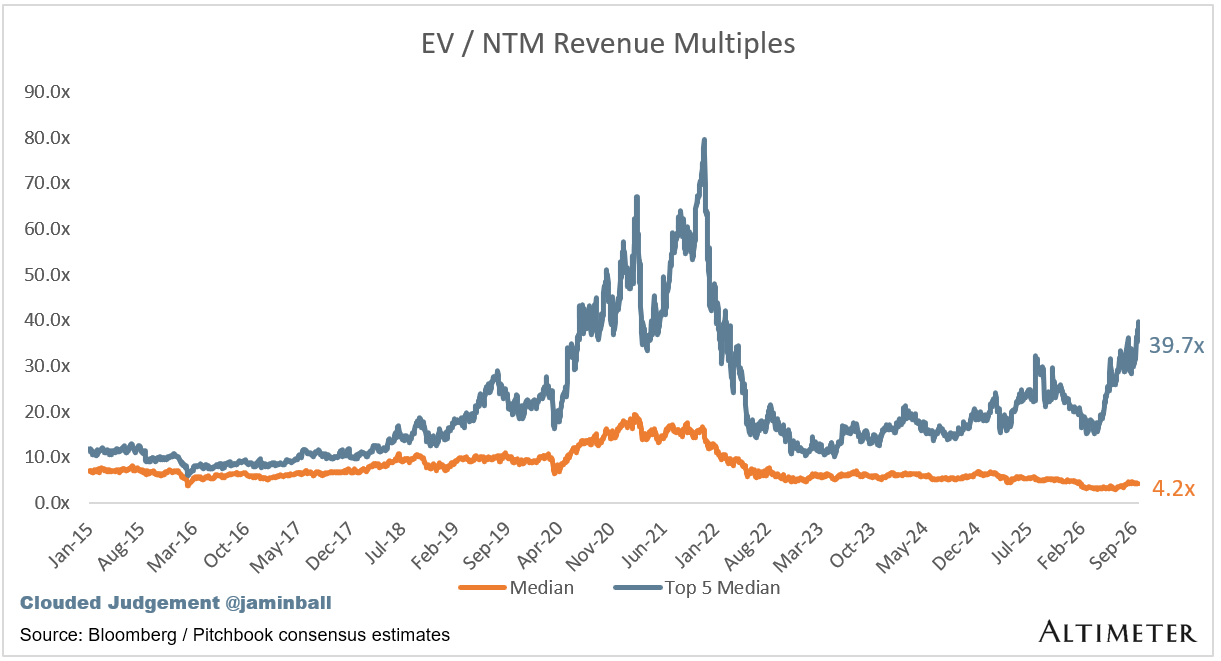
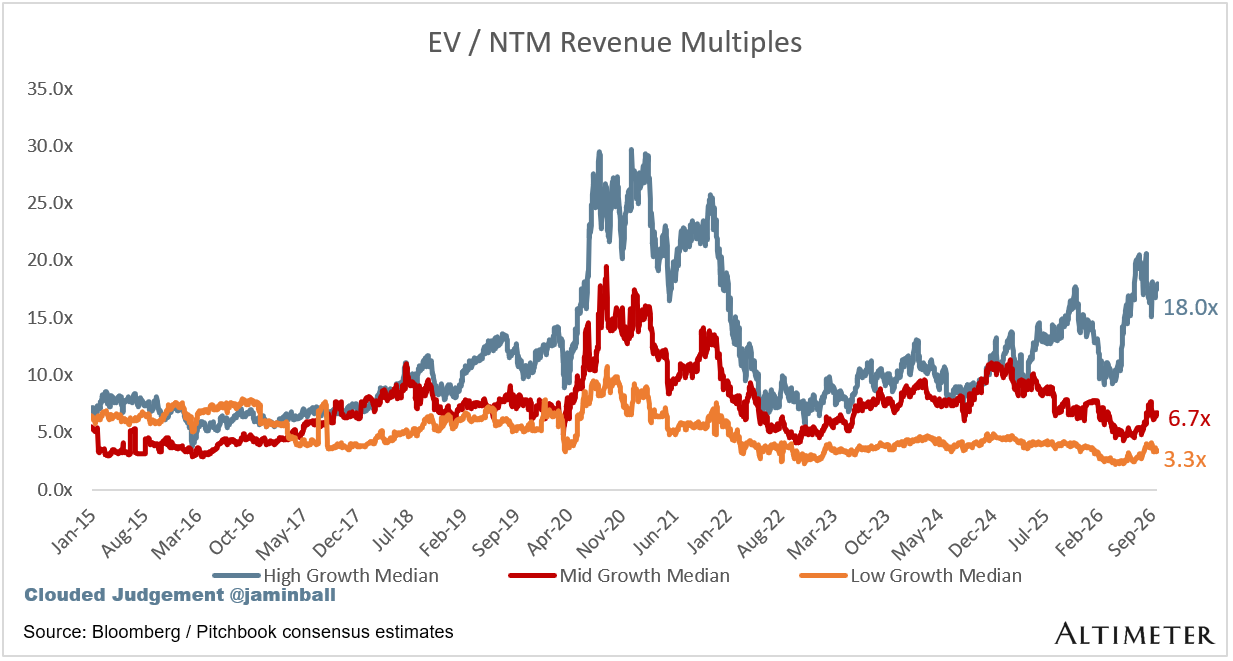
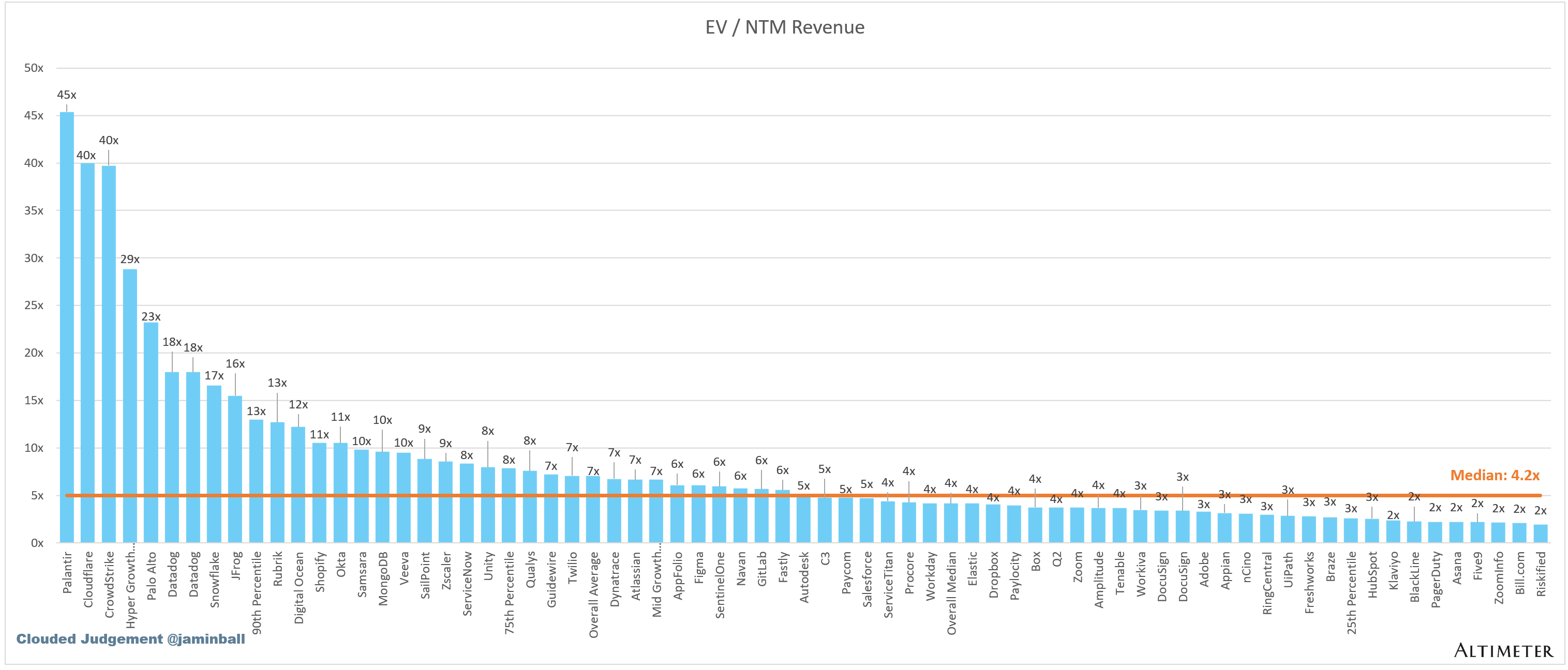
SaaS businesses are generally valued on a multiple of their revenue - in most cases the projected revenue for the next 12 months. Revenue multiples are a shorthand valuation framework. Given most software companies are not profitable, or not generating meaningful FCF, it’s the only metric to compare the entire industry against. Even a DCF is riddled with long term assumptions. The promise of SaaS is that growth in the early years leads to profits in the mature years. Multiples shown below are calculated by taking the Enterprise Value (market cap + debt - cash) / NTM revenue.
Overall Stats:
Overall Median: 4.2x
Top 5 Median: 39.7x
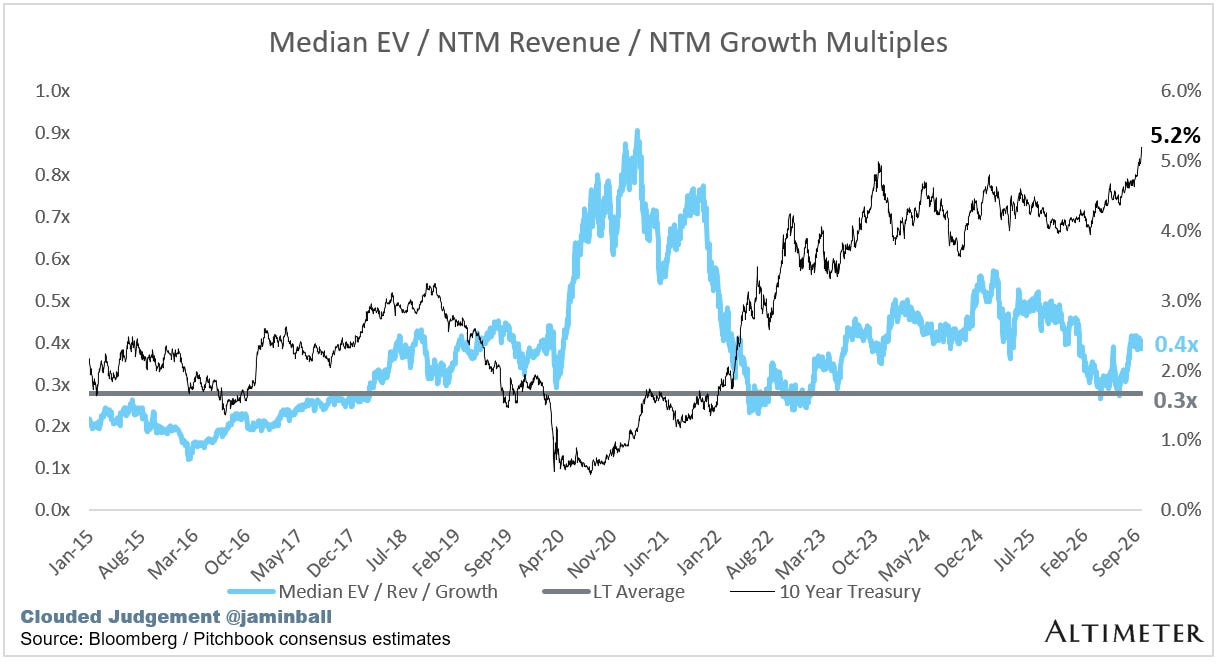
10Y: 5.2%
Bucketed by Growth. In the buckets below I consider high growth >22% projected NTM growth, mid growth 15%-22% and low growth <15%. I had to adjusted the cut off for “high growth.” If 22% feels a bit arbitrary, it’s because it is…I just picked a cutoff where there were ~10 companies that fit into the high growth bucket so the sample size was more statistically significant
High Growth Median: 18.0x
Mid Growth Median: 6.7x
Low Growth Median: 3.3x
EV / NTM Rev / NTM Growth
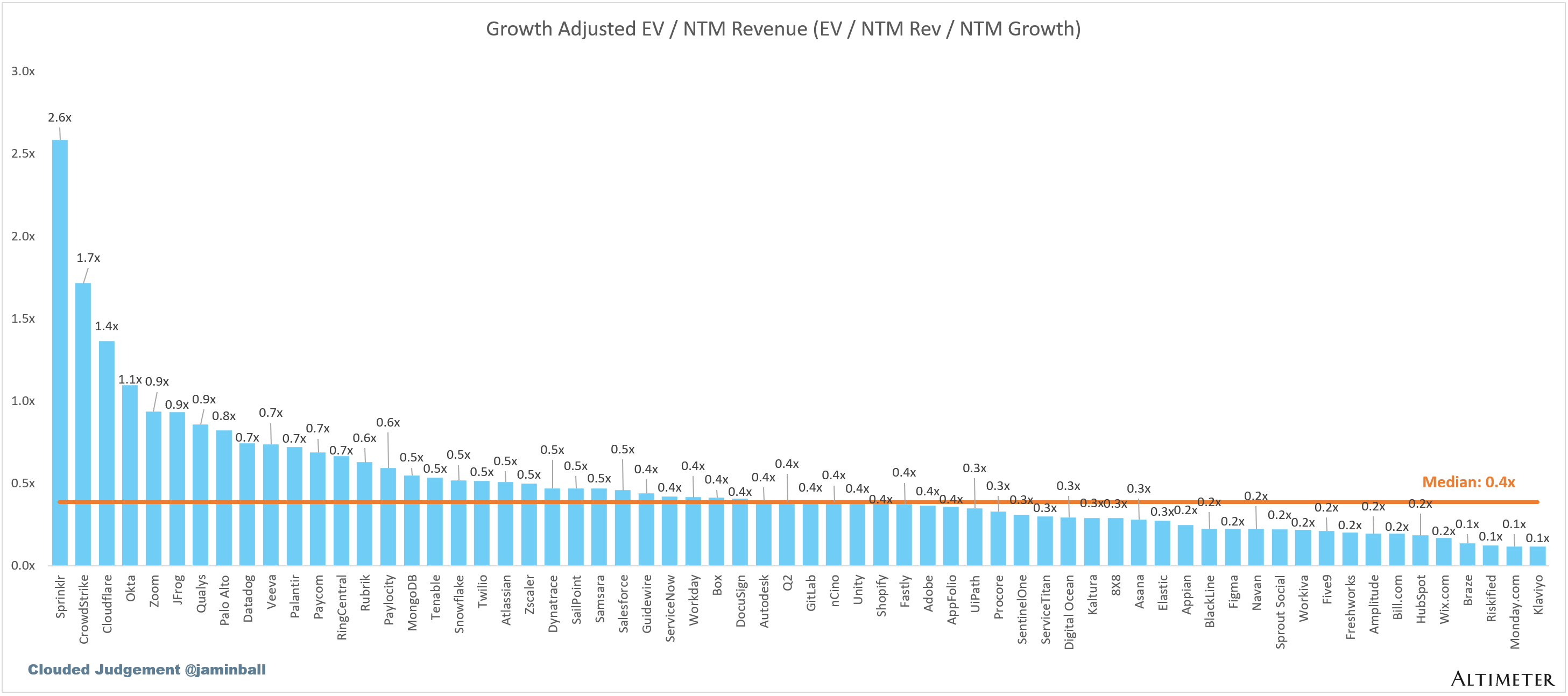
The below chart shows the EV / NTM revenue multiple divided by NTM consensus growth expectations. So a company trading at 20x NTM revenue that is projected to grow 100% would be trading at 0.2x. The goal of this graph is to show how relatively cheap / expensive each stock is relative to its growth expectations.
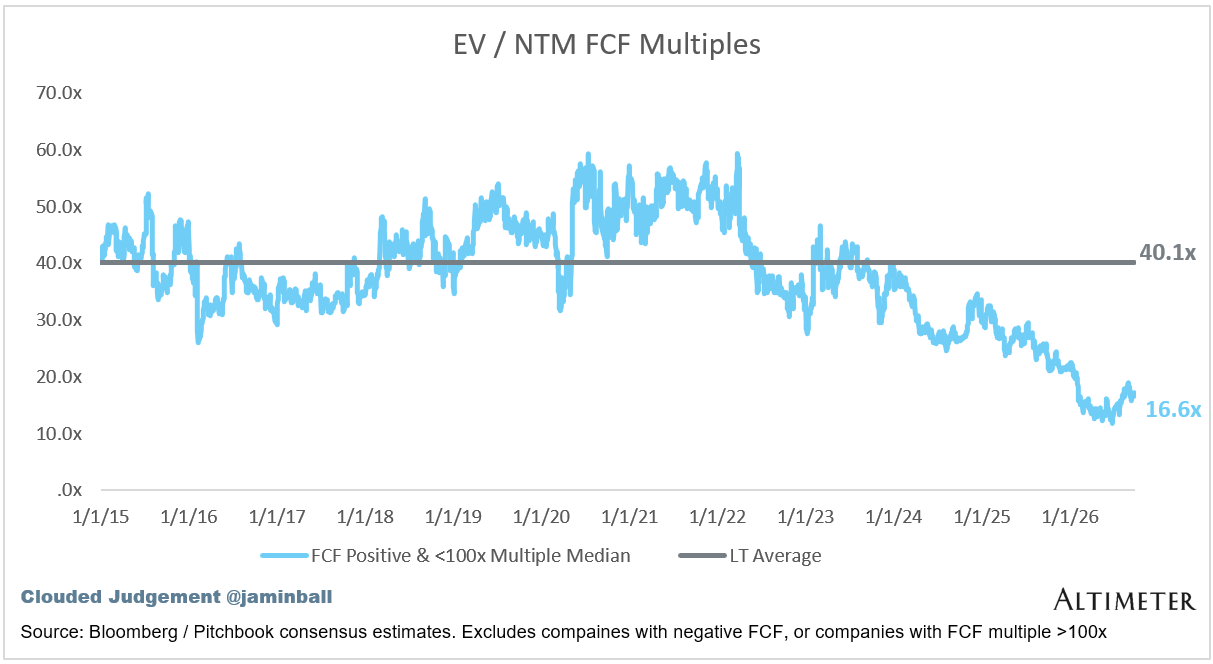
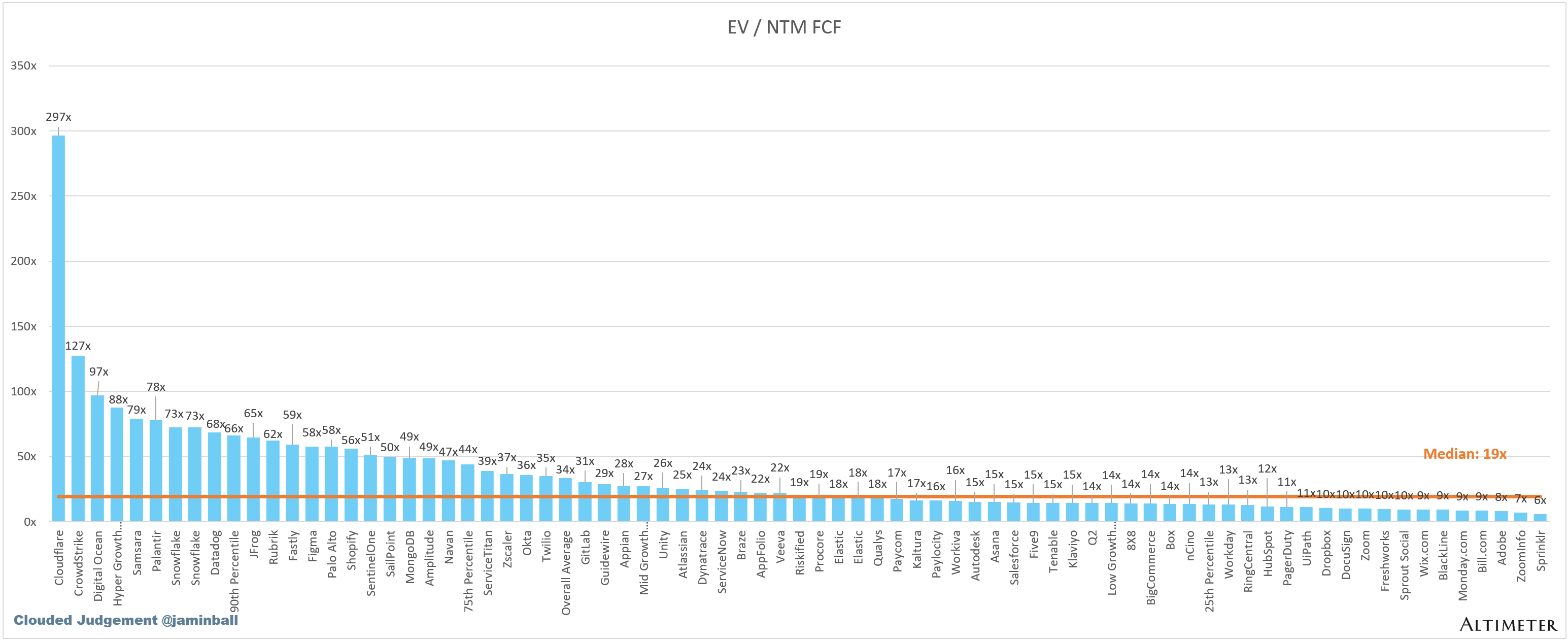
EV / NTM FCF
The line chart shows the median of all companies with a FCF multiple >0x and <100x. I created this subset to show companies where FCF is a relevant valuation metric.
Companies with negative NTM FCF are not listed on the chart
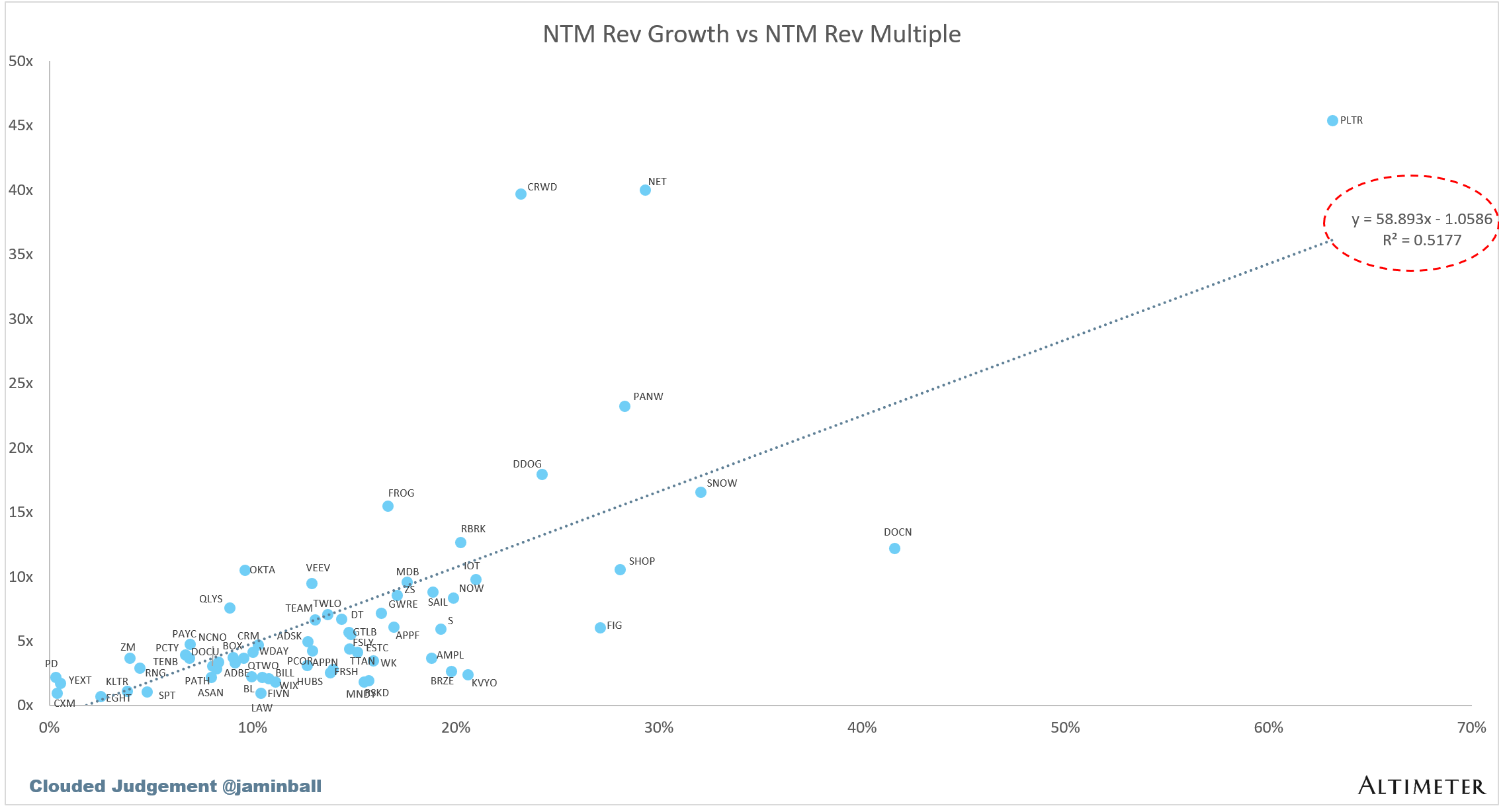
Scatter Plot of EV / NTM Rev Multiple vs NTM Rev Growth
How correlated is growth to valuation multiple?
Operating Metrics
Median NTM growth rate: 13%
Median LTM growth rate: 16%
Median Gross Margin: 76%
Median Operating Margin 4%
Median FCF Margin: 21%
Median Net Retention: 110%
Median CAC Payback: 31 months
Median S&M % Revenue: 34%
Median R&D % Revenue: 22%
Median G&A % Revenue: 13%
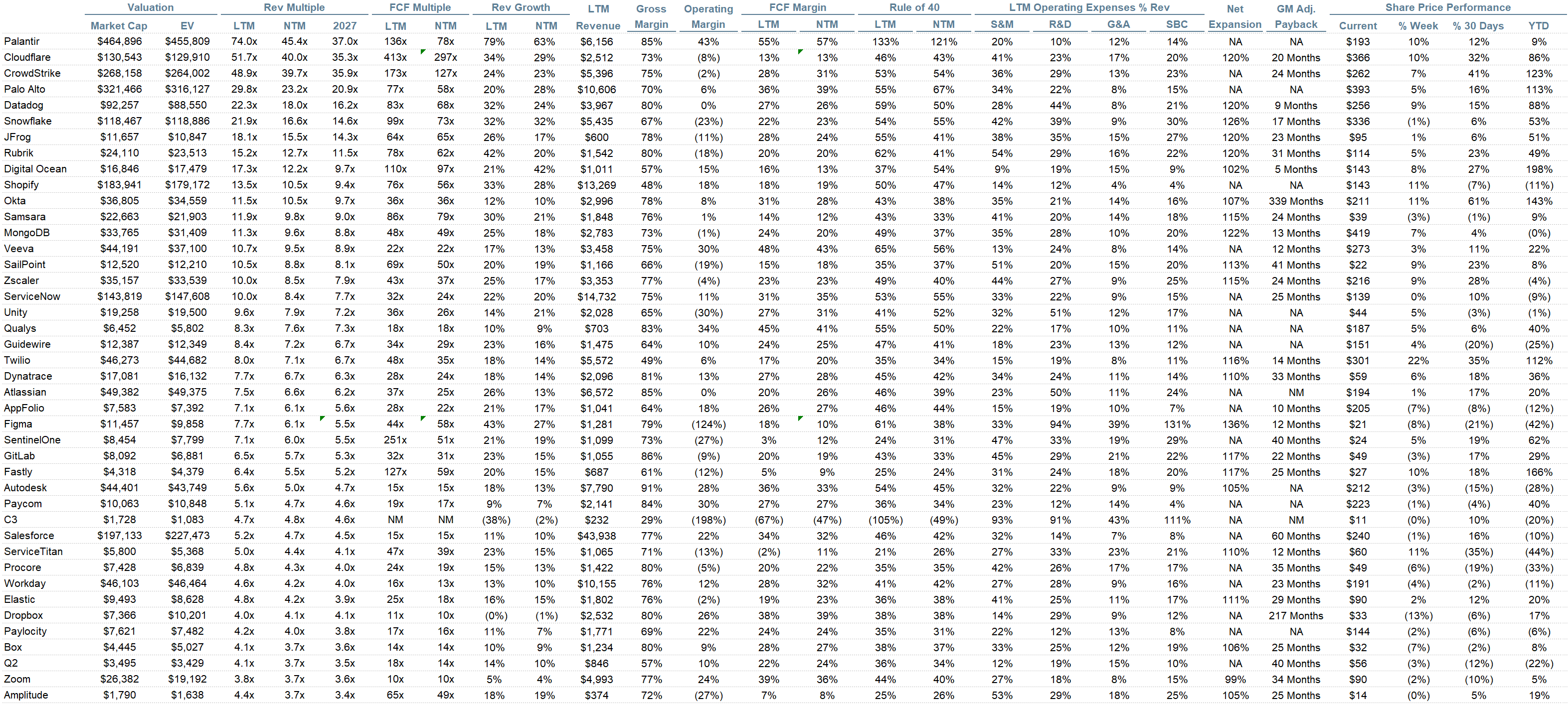
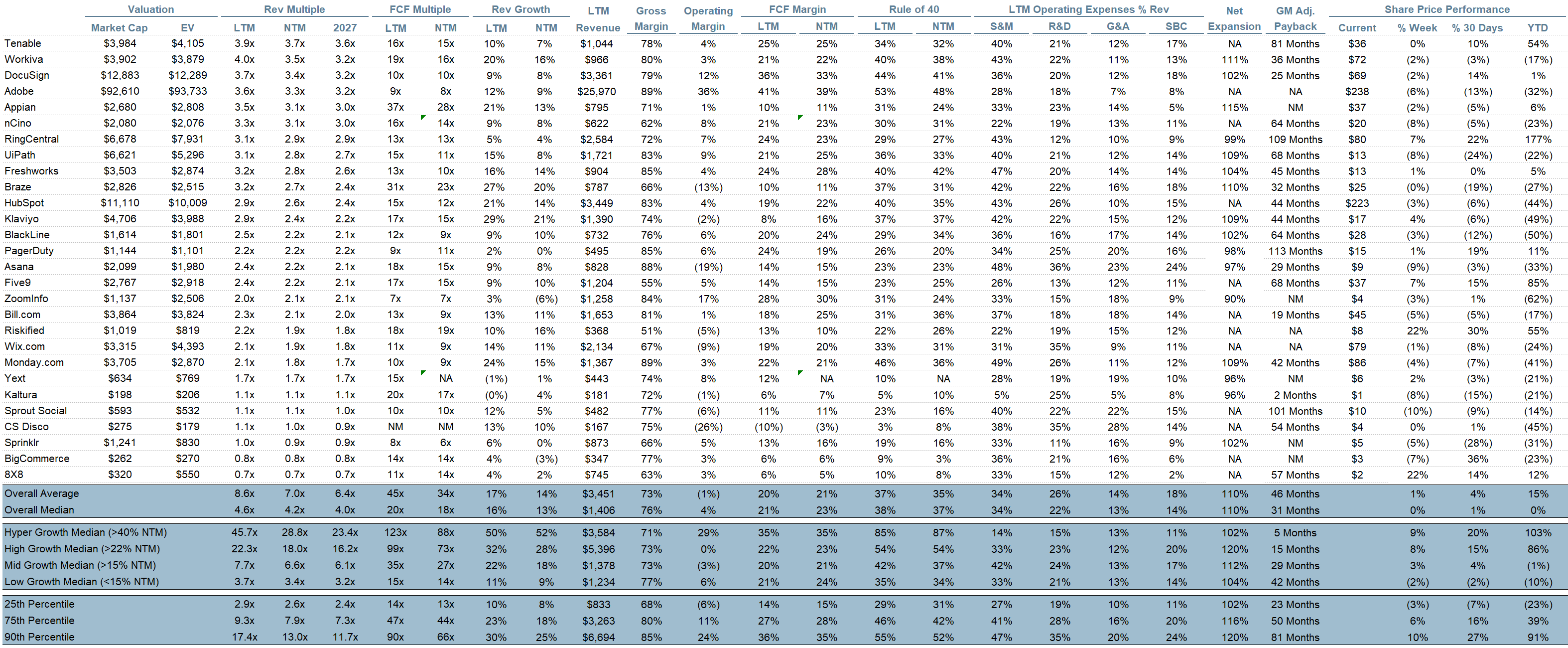
Comps Output
Rule of 40 shows rev growth + FCF margin (both LTM and NTM for growth + margins). FCF calculated as Cash Flow from Operations - Capital Expenditures
GM Adjusted Payback is calculated as: (Previous Q S&M) / (Net New ARR in Q x Gross Margin) x 12. It shows the number of months it takes for a SaaS business to pay back its fully burdened CAC on a gross profit basis. Most public companies don’t report net new ARR, so I’m taking an implied ARR metric (quarterly subscription revenue x 4). Net new ARR is simply the ARR of the current quarter, minus the ARR of the previous quarter. Companies that do not disclose subscription rev have been left out of the analysis and are listed as NA.
Sources used in this post include Bloomberg, Pitchbook and company filings
The information presented in this newsletter is the opinion of the author and does not necessarily reflect the view of any other person or entity, including Altimeter Capital Management, LP (”Altimeter”). The information provided is believed to be from reliable sources but no liability is accepted for any inaccuracies. This is for information purposes and should not be construed as an investment recommendation. Past performance is no guarantee of future performance. Altimeter is an investment adviser registered with the U.S. Securities and Exchange Commission. Registration does not imply a certain level of skill or training. Altimeter and its clients trade in public securities and have made and/or may make investments in or investment decisions relating to the companies referenced herein. The views expressed herein are those of the author and not of Altimeter or its clients, which reserve the right to make investment decisions or engage in trading activity that would be (or could be construed as) consistent and/or inconsistent with the views expressed herein.
This post and the information presented are intended for informational purposes only. The views expressed herein are the author’s alone and do not constitute an offer to sell, or a recommendation to purchase, or a solicitation of an offer to buy, any security, nor a recommendation for any investment product or service. While certain information contained herein has been obtained from sources believed to be reliable, neither the author nor any of his employers or their affiliates have independently verified this information, and its accuracy and completeness cannot be guaranteed. Accordingly, no representation or warranty, express or implied, is made as to, and no reliance should be placed on, the fairness, accuracy, timeliness or completeness of this information. The author and all employers and their affiliated persons assume no liability for this information and no obligation to update the information or analysis contained herein in the future.
Great points. Losing though not loosing.
Great article. I’ve written about this squeeze on Booking-style OTAs before and it's interesting to see it in action now with agents becoming more common place.
Your Expedia–Muse vs Amazon contrast really highlights what even big companies have to choose between: lean in and become inventory, or fight and cede share. I think Amazon will have to give in eventually.
The other question this raises is when people stop opening your app and leave it to their agents, do you still own identity and trust?
https://livioq.substack.com/p/what-happens-when-ai-sits-above-apps